
 14 hours ago
4
Club.noww.in
Most lists of book blurb examples show you ten famous classics: Gone Girl, The Road, The Hunger Games. Those are fine back covers, but they don’t tell a KDP author what is selling on Amazon this week. So on November 24, 2026, I pulled the descriptions of 141 books on Amazon.com’s Kindle best seller charts for Romance, Romantasy and Mystery, Thriller & Suspense, and measured every one of them.
The short answer: self-published bestsellers and publisher-backed bestsellers write blurbs in two different ways. 47% of self-published blurbs open with a short hook line, against 6% of publisher blurbs, which open with a credential (“From the #1 New York Times bestselling author…”) 84% of the time. The common advice to “end on a question” barely shows up: only 4 of 141 blurbs (3%) end on one. What indies put at the end is a promise: standalone, HEA, series order, tropes.
TL;DR
- 47% of self-published Kindle bestsellers open their blurb with a short hook line (median 9 words); 84% of publisher blurbs open with a credential.
- Bestseller blurbs run a median 220 words; 89% are longer than KDP’s suggested 150.
- 59% of self-published romance blurbs name a trope (publishers: 30%); enemies to lovers leads.
- Only 4 of 141 blurbs end on a question. 41% of indie blurbs end on a promise: standalone, HEA, series order.
- Examples table, genre breakdown and a free blurb checker below.
How I built this set of book blurb examples
I fetched the three Kindle best seller charts on Amazon.com (the ranks Amazon renders on the page: 1 to 30 and 51 to 80 of each chart), then opened each book’s product page and pulled the description text. That gave 180 chart slots. Amazon’s bot check blocked 24 product pages, mostly in the Mystery and Romantasy charts, so the dataset is 156 chart slots and 141 unique blurbs (some books sit on two charts). I classed a book as self-published when its Amazon page lists no publisher, which is how a KDP book shows up unless the author types in an imprint name (73 books), and publisher-backed otherwise (68 books, 12 of them from Amazon Publishing imprints such as Montlake and Thomas & Mercer). The pattern checks are simple text rules; I spot-read the matches and fixed false hits like “pulled the trigger”. Treat each percentage as plus or minus a few points.
If you are earlier in the process and the book behind the blurb doesn’t exist yet, ImagineYourBook is an AI book-writing tool that turns a prompt or your notes into a complete ~10,000-word draft with a cover, exports Word and EPUB, and drafts a book description from your finished book that you can then reshape with the patterns below. Its Series Builder carries characters and world rules into Book Two.
Self-published vs publisher blurbs: two different playbooks
 Two playbooks: publishers sell authority, self-published authors sell the reading experience.
The chart is the main finding. Publisher blurbs lean on authority: a credential in the first line (84%), a credential somewhere in the copy (90%), and review quotes or press praise (40%). Self-published blurbs lean on the reader’s genre wishes instead:
- Hook first. 47% open with a line of 15 words or fewer, with a median of 9 words. Another 25% start straight into the story. Only 27% open with a credential, and many of those are authors who have one (USA Today, Amazon Charts).
- Tropes by name. In Romance and Romantasy, 59% of self-published blurbs name at least one trope, against 30% of publisher blurbs. The most common: enemies to lovers (17 blurbs), forced proximity (10) and slow burn (9).
- First person. 37% of self-published blurbs tell the story in first person (“My ex tried to auction me off in a room full of masked killers.”), against 12% of publisher blurbs.
- A closing promise. 41% end on a promise line (standalone, HEA, no cliffhanger, series order, content note), against 22% of publisher blurbs. HEA or standalone promises show up in 19% of indie blurbs and 3% of publisher ones.
There is a twist in the praise numbers. KDP’s metadata guidelines list “reviews, quotes, or testimonials” among things it cannot accept in a description, and its Write a Book Description page also bans Unicode emojis. Publisher blurbs carry review quotes 40% of the time; only 5 of the 73 self-published bestsellers (7%) do. Don’t copy the publisher habit into your KDP description box.
Book blurb examples by pattern
These are real opening and closing lines from today’s charts, quoted short, with the book’s chart and rank so you can read the whole blurb on Amazon.
| Short hook line (self-published) | “Her foster daughter just turned sixteen.” | My Foster Daughter is a Shifter (Lindsey Devin) | Romance #9 |
| POV hook (self-published) | “POV: You get accidentally added to a stranger’s family group chat.” | I Accidentally Joined a Wolf Shifter Group Chat (Roxie Ray) | Romance #3 |
| First-person hook (self-published) | “I left a voicemail on a stranger's phone.” | The Voicemail (Natasha L. Black) | Romance #30 |
| Thriller hook (self-published) | “She married the man of her dreams, only to become his worst nightmare.” | The Housewife (Natalie Barelli) | Mystery & Thriller #74 |
| Credential opener (publisher) | “From #1 New York Times bestselling author Rebecca Yarros comes a slow-burn romance about love, family, and what it means to become…” | Peculiar Stars (Rebecca Yarros) | Romance #1 |
| Tropes inside a sentence (closing line) | “A steamy standalone small-town marriage of convenience romance featuring a single dad who falls first, a heroine who calculated everything except love,…” | The Marriage Mistake (Lilian Monroe) | Romance #64 |
| Promise line (closing line) | “Standalone × No Cheating × No Cliffhanger × HEA Guaranteed” | Masked Don (K.C. Crowne) | Romance #22 |
| Content note (closing line) | “Content warning: discussions of drink spiking and predatory behaviour.” | Deal Breaker (Susie Tate) | Romance #23 |
| Series order (closing line) | “DEVIL'S RECEIPTS is Book One of the Trusov Bratva duet. Damon and Melody's story concludes in Book Two, DEVIL'S GROVEL.” | Devil’s Receipts (Nicole Fox) | Romance #16 |
The two shortest blurbs in the whole set sit near the top of the Romance chart: Roxie Ray’s group-chat book at #3 runs 45 words and Lindsey Devin’s foster-daughter book at #9 runs 35. A strong title, cover and concept can carry a tiny blurb. Most bestsellers still use 200 words or more.
How long should a book blurb be? KDP says 150, bestsellers use 220
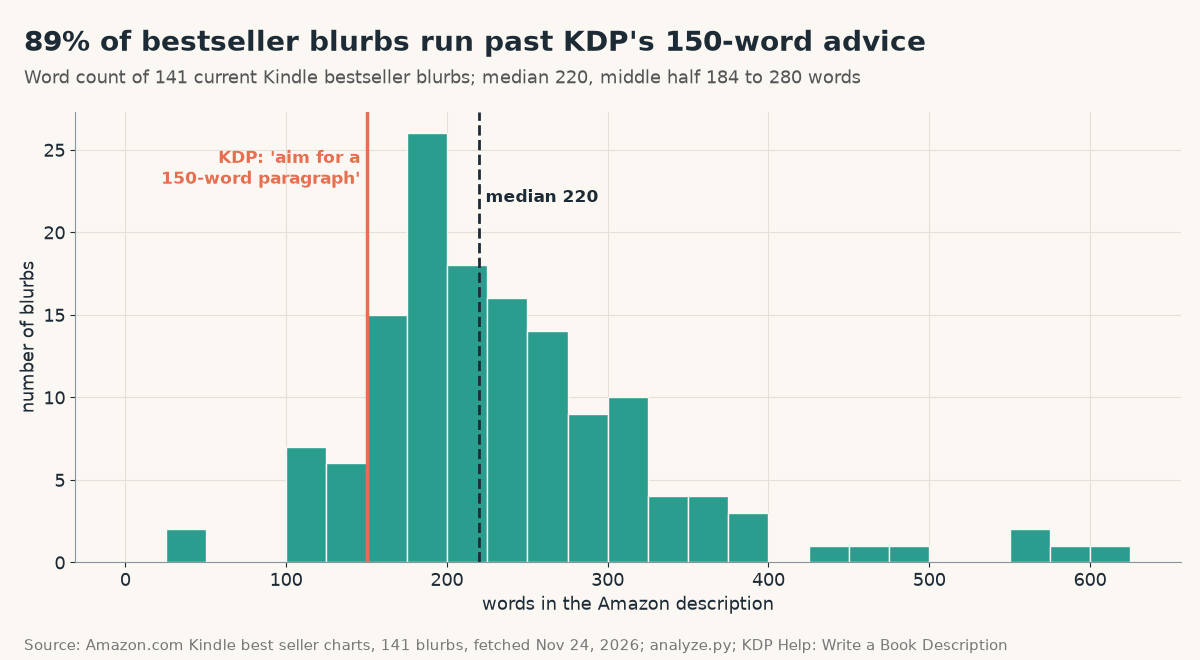 The 150-word advice is a floor in practice: only 11% of bestseller blurbs are that short.
KDP’s help page tells authors to “aim for a 150-word paragraph”. The bestsellers don’t: 89% run longer than 150 words, the median is 220 words, and the middle half sits between 184 and 280. Self-published blurbs are a little shorter (median 211) than publisher blurbs (median 238.5), and they are cut into more pieces: a median of 9 paragraphs or lines against 7, because indies use one-line paragraphs for rhythm.
The 4,000-character limit never binds. The longest blurb in the set is 3,521 characters and the median is 1,286, about a third of the box. KDP counts HTML tags toward the limit (bold “test” costs 11 characters, not 4), and 94% of the blurbs use bold somewhere, usually on the first line. Amazon’s desktop page also collapses the description at 280 pixels behind a “Read more” link, so the first lines carry most of the selling. We covered the length and banned-content rules in detail in Amazon Book Description Generator: KDP Says 150 Words.
The genres write different blurbs too
| Blurbs measured (chart slots) | 60 | 49 | 47 |
| Median words | 222.5 | 221 | 220 |
| Credential in first line | 60% | 49% | 62% |
| Short hook first line (15 words or fewer) | 18% | 27% | 32% |
| Names a trope | 50% | 41% | 11% |
| Mentions a series, book number or duet | 40% | 65% | 28% |
| Heat words (spicy, steamy, explicit…) | 25% | 35% | 11% |
| Content note | 10% | 20% | 6% |
| Review quotes or praise | 22% | 16% | 30% |
| Contains a question | 52% | 35% | 43% |
| Ends on a promise line | 40% | 49% | 9% |
| Ends on a question | 3% | 2% | 2% |
Romantasy blurbs are the most series-heavy (65% mention a series, book number or duet) and the most likely to signal heat (35%) or add a content note (20%). Mystery and thriller blurbs almost never close on a promise (9%); 74% end on a story line, usually a threat or a reversal. Romance blurbs ask the most questions (52% contain at least one), but almost never as the last line.
Why the last line is a promise, not a question
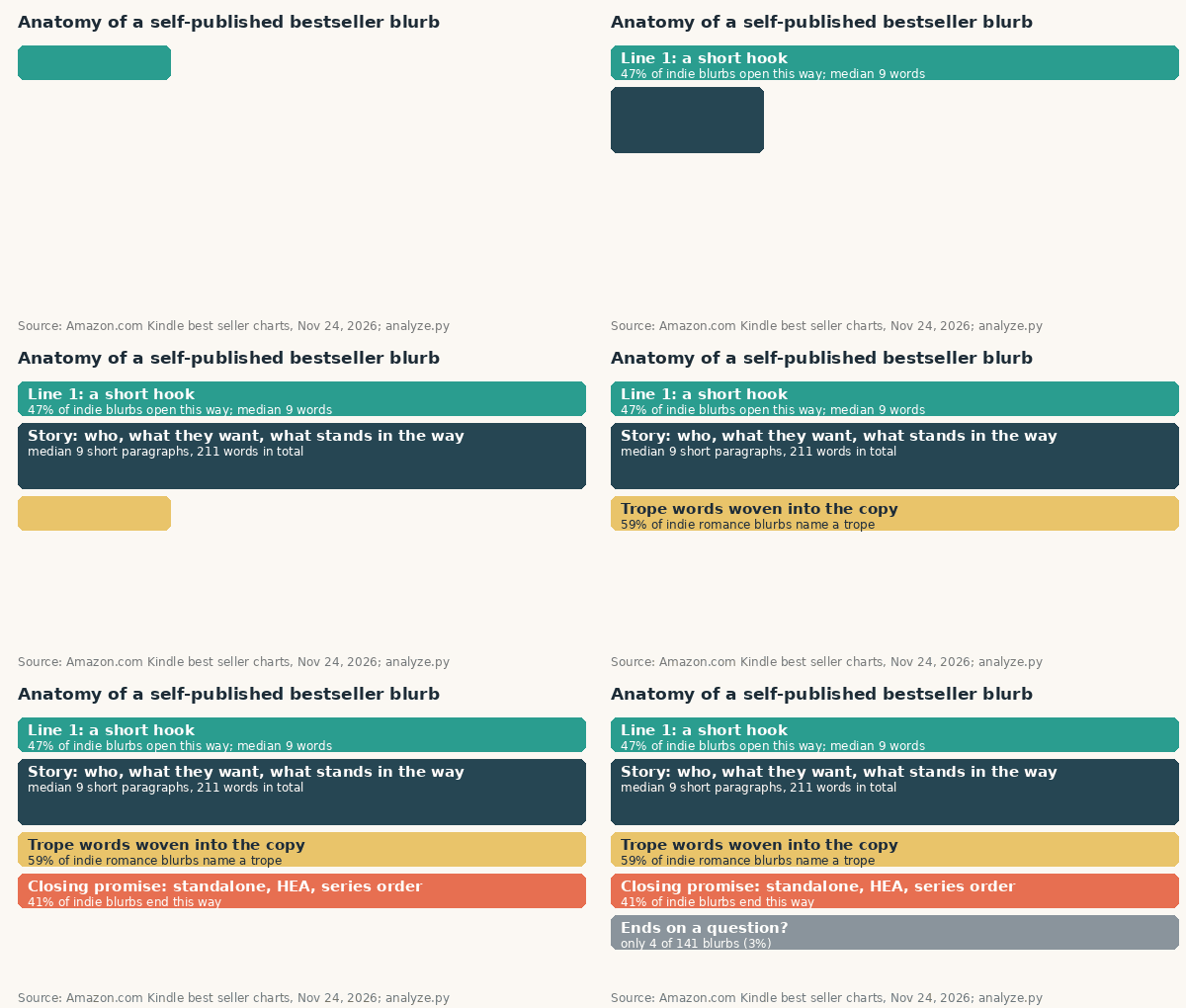 The indie blurb template, step by step, with the share of bestsellers that use each part.
A question as the final line (“Will she risk her heart?”) is the textbook ending. Only 4 of 141 bestseller blurbs do it, even though 45% use a question somewhere in the middle. The indie ending is a contract with the reader: “Standalone × No Cheating × No Cliffhanger × HEA Guaranteed” (K.C. Crowne, #22 Romance), or a full sentence like Lilian Monroe’s “A steamy standalone small-town marriage of convenience romance featuring a single dad who falls first…” (#64 Romance). For a Kindle Unlimited reader deciding whether to spend an evening on your book, “no cliffhanger” answers the real question.
One caution: KDP also bans “any keywords or book tags phrases” in the description. A bare tag-style list such as “Tropes: …” (about 12% of self-published blurbs) sits close to that line. Working the tropes into a sentence, as Monroe does, gets the same signal across with less risk.
Napkin math: what a better blurb is worth
A blurb doesn’t bring visitors; it converts them. Assume (my assumption, not a measured rate) that a book gets 1,000 product page visits a month. A $4.99 ebook at the 70% royalty earns about $3.39 per sale after a delivery fee of about $0.10 for a text-only file (KDP eBook Royalties; file-size math in our KDP delivery fee breakdown). Each extra percentage point of page conversion is then 10 sales, or $33.90 a month, $406.80 a year, per book. Across a 10-book catalog that is $4,068 a year from one point. That is why it pays to rewrite the blurb before you buy another ad.
Check your own blurb against the bestsellers
Paste your description below. The checker runs in your browser and compares it with the medians from the 141 bestsellers and with KDP’s banned list.
Book blurb checker (vs 141 Kindle bestsellers)
Check my blurb
Paste a blurb above.
Benchmarks: Amazon.com Kindle best seller charts (Romance, Romantasy, Mystery, Thriller & Suspense), 141 blurbs, November 24, 2026. Banned list: KDP Help, Write a Book Description. Simple text rules, so read the flags with judgment. Nothing you paste leaves your browser.
A 6-step blurb recipe from the data
- Line 1: a hook of 15 words or fewer, unless you have a real credential. Bold it.
- Name the genre and one or two tropes inside a sentence, not as a tag list.
- Tell the setup in short paragraphs. First person is common in indie romance (37%) if the book is first person.
- Stop the story on stakes, not on a question.
- Close with a promise line: standalone or series order, HEA, heat level, content note if the book needs one.
- Check KDP’s banned list: no review quotes, emojis, prices, links or “free”. If an AI tool drafted it, the @iyb7 Medium walk-through on prompting a blurb that passes KDP’s rules shows a before and after. For the keyword fields that sit next to the blurb, see KDP keywords examples, and for the byline above it, how to choose a pen name.
| How self-published bestsellers open | 47% short hook line, median 9 words | Lead with a hook unless you have a real credential |
| How publisher bestsellers open | 84% credential first line | Don’t fake authority; a hook beats a weak credential |
| Blurb length | median 220 words (184 to 280) | 150 to 280 words; KDP’s 150 is a floor in practice |
| Tropes named (romance) | 59% self-published vs 30% publisher | Name one or two tropes inside a sentence |
| Closing line | 41% of indie blurbs end on a promise; 3% of all end on a question | Close with standalone/HEA/series order, not a question |
| Review quotes | 40% publisher vs 7% self-published | Leave them out: KDP lists them as not accepted |
| One point of conversion | $406.80 a year per book at 1,000 visits/month (assumption) | Rewrite the blurb before buying more ads |
Limits of this data. It is one day of three US charts, 141 books, and a bestseller’s blurb is not proof that the blurb caused the sales: famous names and big ad budgets sell books with any description. The self-published label is a proxy (no publisher listed). What the data does show is what readers in these genres see from the books that are selling right now.
FAQ
How long should a book blurb be?
KDP suggests a 150-word paragraph, but 89% of 141 current Kindle bestsellers run longer. The median is 220 words, and the middle half falls between 184 and 280 words. Self-published bestsellers are a little shorter, with a median of 211.
How do bestselling blurbs start?
Self-published bestsellers usually open with a short hook line: 47% use 15 words or fewer, median 9. Publisher-backed bestsellers open with a credential such as a New York Times bestseller line 84% of the time.
Should a book blurb end with a question?
Rarely. Only 4 of 141 bestseller blurbs end on a question, although 45% use one somewhere. Self-published blurbs more often end on a promise line: standalone, HEA, no cliffhanger or series order (41%).
Can I put reviews or quotes in my Amazon book description?
KDP lists reviews, quotes and testimonials among things it cannot accept in a description, along with emojis, links, prices and keyword tag phrases. 40% of publisher blurbs carry praise, but only 7% of self-published ones.
Should I list tropes in my blurb?
In romance, yes: 59% of self-published bestseller blurbs name at least one trope, most often enemies to lovers. Weave them into a sentence; KDP bans bare keyword or tag phrases in descriptions.
The takeaway
The best book blurb examples for a KDP author are not the classics; they are the self-published books on this week’s charts. Those open with a 9-word hook, name the trope, and close on a promise rather than a question. If you are building a series and the next book isn’t written yet, ImagineYourBook turns your idea into a ~10,000-word draft with a cover and a drafted description you can rework with the six steps above. You pay $0 today for one 10,000-word book during a seven-day trial; a card is required, and the first $24.99 monthly charge comes after seven days unless you cancel before day eight. For a bigger picture of the series business behind the blurb, read how to write a romance book series and Finxter’s guide to making money with AI.
Sources (checked November 24, 2026): Amazon.com Best Sellers: Kindle Romance · Amazon.com Best Sellers: Kindle Romantasy · Amazon.com Best Sellers: Kindle Mystery, Thriller & Suspense · KDP Help: Write a Book Description (150 words, 4,000 characters, HTML, restrictions) · KDP Metadata Guidelines for Books (description restrictions) · KDP Help: eBook Royalties · ImagineYourBook pricing and trial terms. Data: descriptions of 141 books (156 chart slots) from Amazon.com product pages, collected November 24, 2026; 24 of 180 product pages were blocked by Amazon’s bot check and are excluded. Classification rules: analyze.py. Napkin math assumes 1,000 product page visits a month and a $4.99 ebook.



 English (US)