
 2 hours ago
2
Club.noww.in
The Python sorted function takes any iterable and returns a new sorted list. Your original data stays untouched, and key and reverse control the order.
print(sorted([3, 1, 2])) # [1, 2, 3]In this tutorial, I’ll show you its syntax and five examples: numbers and strings, descending order, custom keys, dictionaries and multiple sort keys. I ran every one in Python 3.12.5 in VS Code.
Python sorted() Syntax
sorted(iterable, /, *, key=None, reverse=False)| iterable | Yes | none | List, tuple, set, string, dict or generator |
| key | No | None | One-argument function that returns the sort value |
| reverse | No | False | True sorts in descending order |
Return value: a new list, always, whatever type you pass in. The / and * mean key and reverse must be passed by name.
Note: Python’s sort is stable, so equal items keep their original order. For the algorithm behind it, see which sorting algorithm Python uses.
When to Use sorted() in Python
- Ranking scores or prices but keeping the source list
- Sorting tuples, sets, strings or dictionary keys
- Ordering records by one or more fields
Working with arrays as well? My sorting arrays and lists in Python tutorial covers both.
Example 1: Sort a List of Numbers or Strings with sorted()
Let me start with a list of test scores and a set of US cities:
scores = [88, 72, 95, 61, 79] ranked = sorted(scores) print(ranked) print(scores) print(sorted({"Denver", "Austin", "Boston"}))Output:
[61, 72, 79, 88, 95] [88, 72, 95, 61, 79] ['Austin', 'Boston', 'Denver']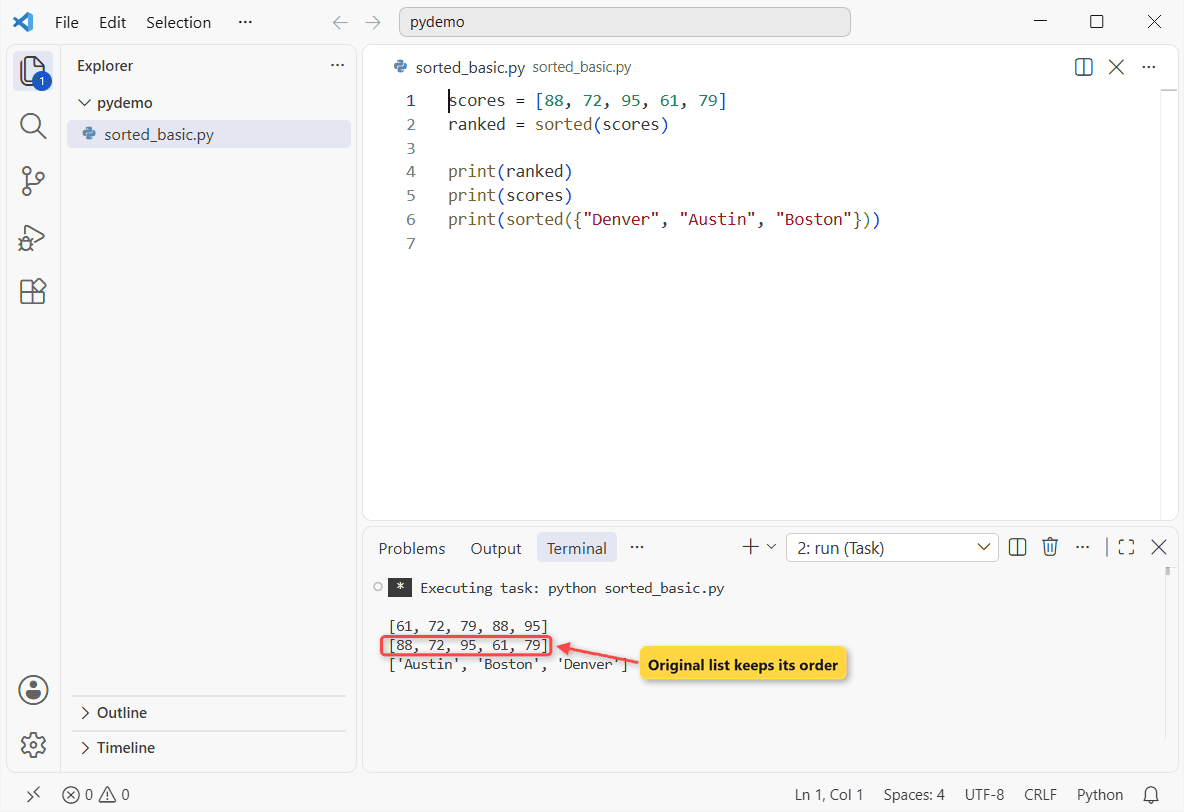 The original scores list keeps its order.
How does this work? sorted() built a new list, so scores kept its order. The set came back as an alphabetical list, like in sorting a list alphabetically.
Example 2: Sort a List in Descending Order with sorted()
Pass reverse=True to list invoice amounts from biggest to smallest:
invoices = [1249.50, 89.99, 4300.00, 615.25] for amount in sorted(invoices, reverse=True): print(f"${amount:>9,.2f}")Output:
$ 4,300.00 $ 1,249.50 $ 615.25 $ 89.99How does this work? the amounts came back largest first, and the f-string right-aligns them.
Example 3: How Do You Sort with a key Function in Python?
Uppercase letters sort before lowercase. A key function fixes that:
cities = ["seattle", "Austin", "chicago", "Miami"] print(sorted(cities)) print(sorted(cities, key=str.lower)) print(sorted(cities, key=len))Output:
['Austin', 'Miami', 'chicago', 'seattle'] ['Austin', 'chicago', 'Miami', 'seattle'] ['Miami', 'Austin', 'seattle', 'chicago']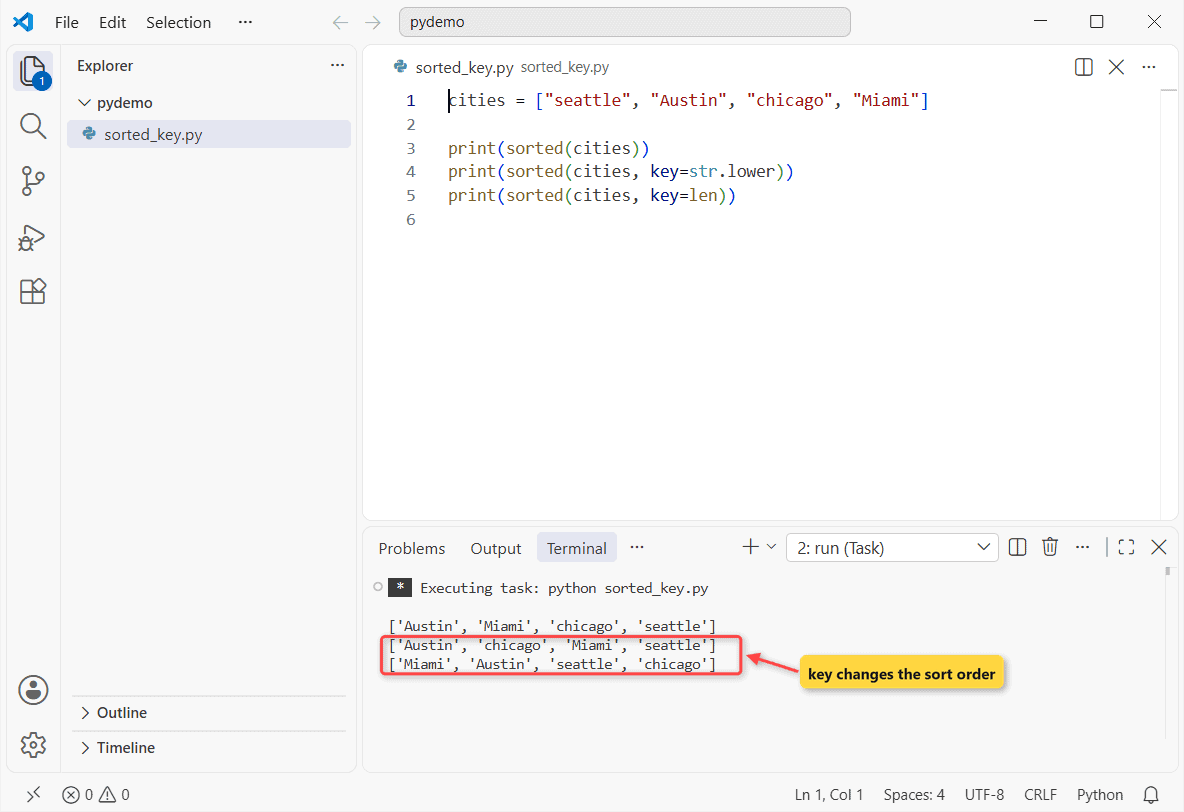 Three orders for the same four cities.
How does this work? capitals came first in the plain sort. key=str.lower compared lowercase copies, and key=len sorted by length.
Example 4: Sort a Dictionary by Value with sorted()
sorted() on a dictionary returns its keys. Sort .items() to rank states by sales:
sales = {"Texas": 18450, "Ohio": 9320, "California": 24780} print(sorted(sales)) top = sorted(sales.items(), key=lambda kv: kv[1], reverse=True) for state, total in top: print(f"{state:<11}${total:,}")Output:
['California', 'Ohio', 'Texas'] California $24,780 Texas $18,450 Ohio $9,320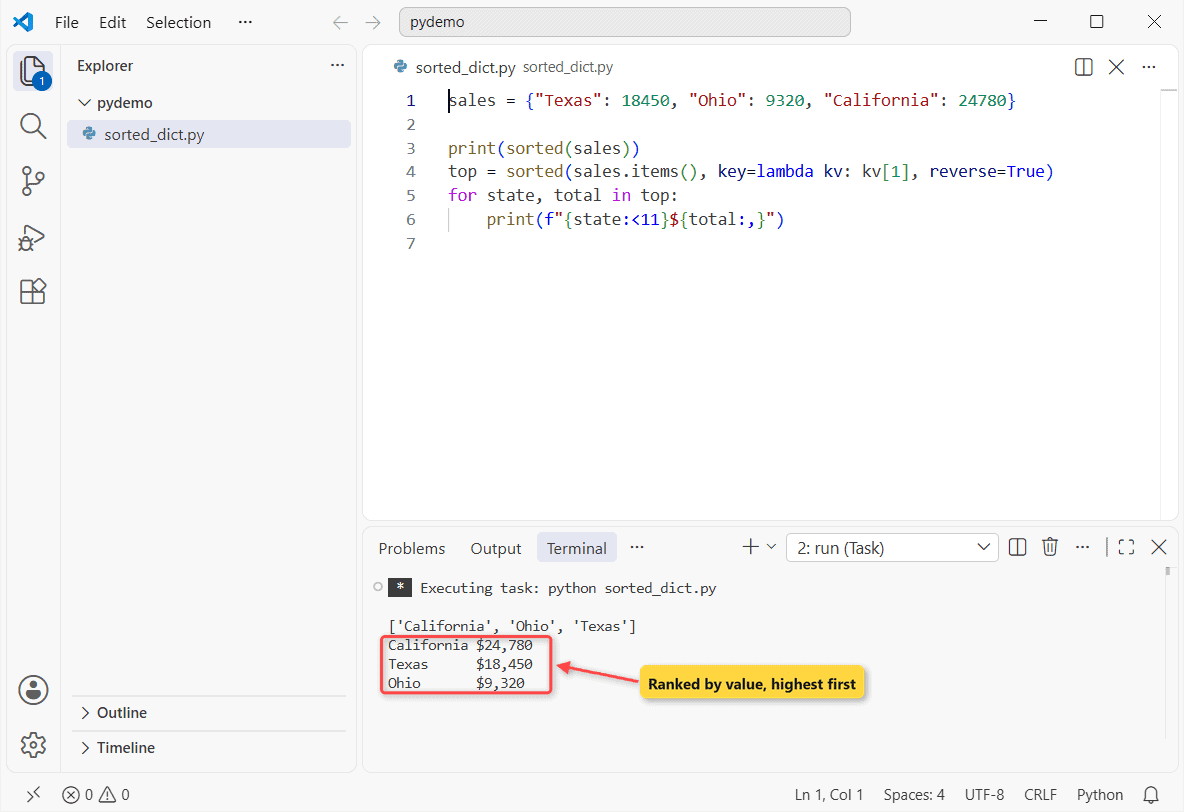 Keys, then states ranked by sales.
How does this work? the lambda picks the total from each (state, total) tuple. More options: sorting a dictionary by value.
Example 5: Sort a List of Dictionaries by Multiple Keys
Return a tuple from key to sort by state, then by total from high to low:
orders = [ {"id": 1043, "state": "TX", "total": 89.99}, {"id": 1044, "state": "CA", "total": 249.00}, {"id": 1045, "state": "TX", "total": 310.50}, {"id": 1046, "state": "CA", "total": 55.25}, ] by_state = sorted(orders, key=lambda o: (o["state"], -o["total"])) for o in by_state: print(o["state"], o["id"], f"${o['total']:.2f}")Output:
CA 1044 $249.00 CA 1046 $55.25 TX 1045 $310.50 TX 1043 $89.99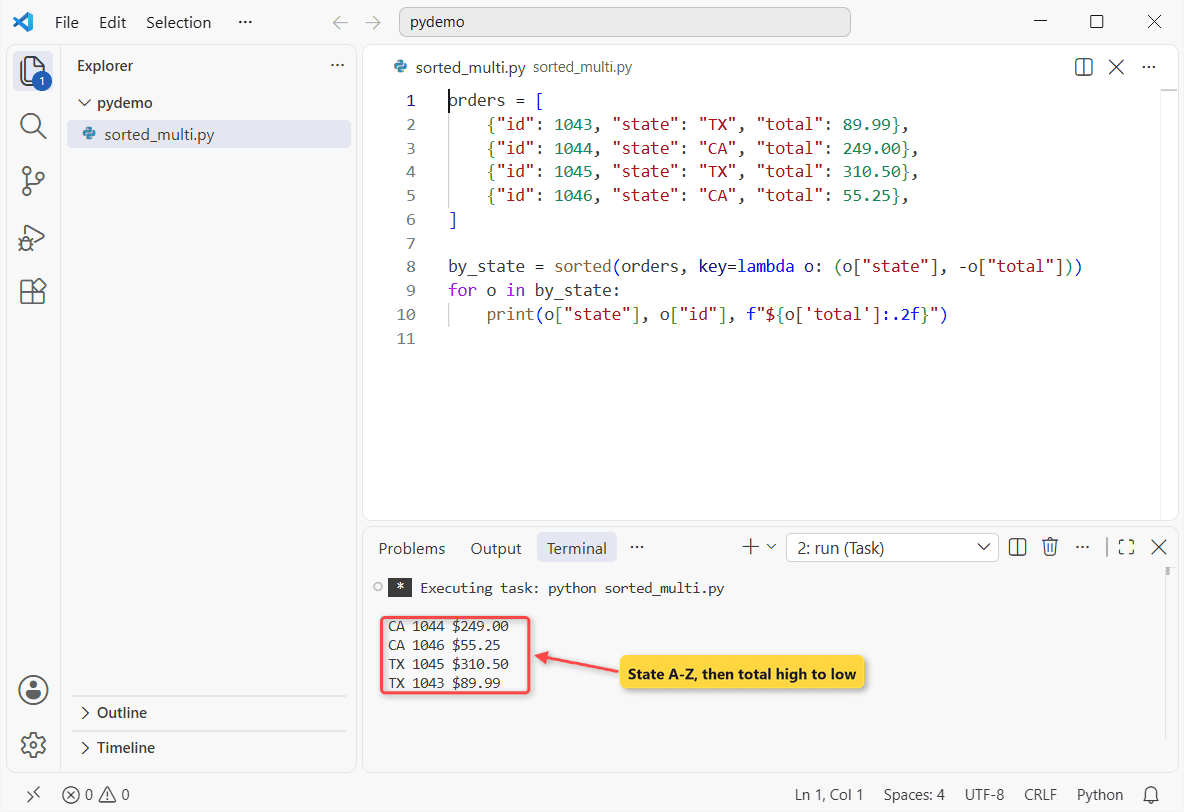 CA first, biggest order on top in each state.
How does this work? Python compares the tuples field by field, and the minus sign flips the total. For classes, read sorting a list of objects by attribute.
sorted() vs list.sort() in Python
| Works on | Any iterable | Lists only |
| Returns | A new list | None |
| Original data | Unchanged | Changed in place |
Pick sorted() to keep the original or sort a non-list; pick list.sort() for big lists. For a pandas DataFrame, you’d use sort_values() in pandas.
Common Mistakes with Python sorted()
Here are the errors I see most often with Python sorting:
try: sorted([3, "10", 7]) except TypeError as err: print("1. TypeError:", err) try: sorted([12, 4, 9], len) except TypeError as err: print("2. TypeError:", err) nums = [12, 4, 9] print("3.", nums.sort())Output:
1. TypeError: '<' not supported between instances of 'str' and 'int' 2. TypeError: sorted expected 1 argument, got 2 3. None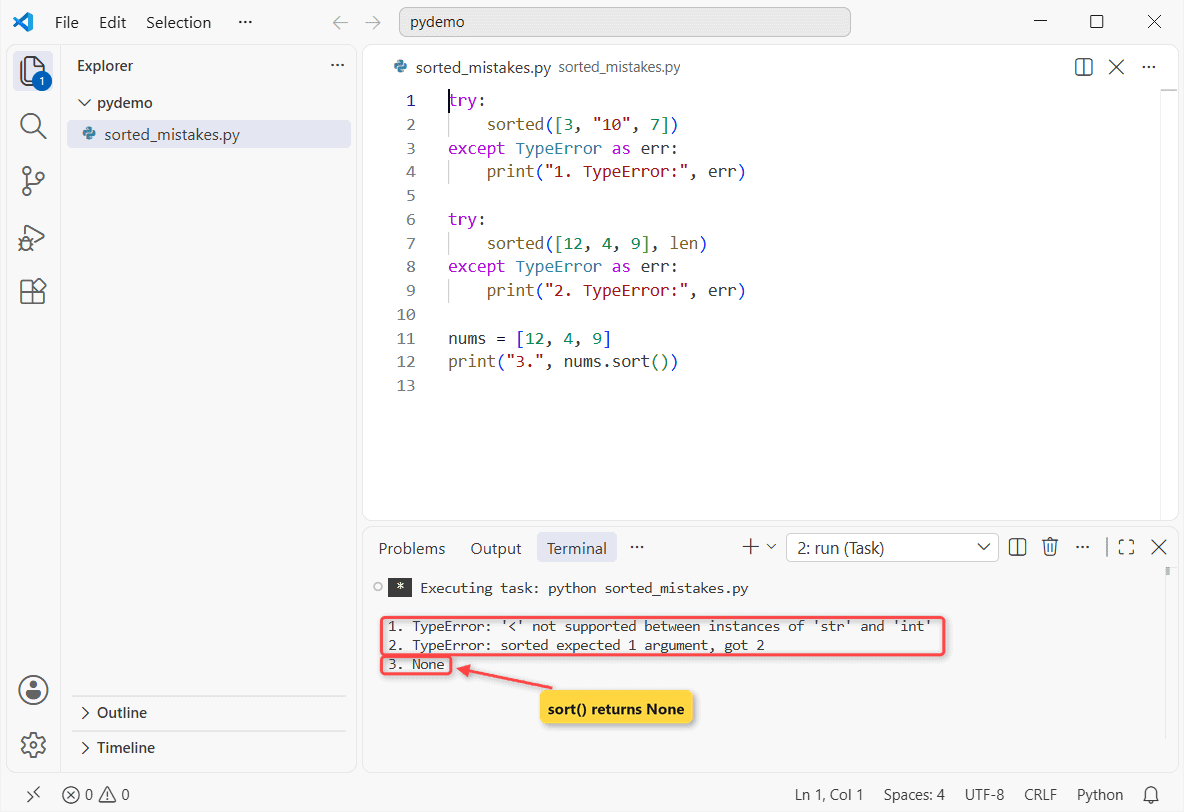 Two TypeErrors and one silent None.
- Mixed types like str and int can’t be compared.
- key is keyword-only, so sorted(nums, len) fails.
- list.sort() returns None; don’t assign its result.
Wrapping Up the Python sorted() Function
Python’s sorted() function returns a new, stable, sorted list from any iterable, and key plus reverse cover nearly every custom order.
To see sorting done by hand, try sorting a list without sort(), then browse more Python built-in functions and methods.
You’ll find more sorting practice here:
- sort a Python dictionary by key and value
- sort a list of tuples in Python
- sort a list of lists in Python
- sort a string in Python
Python sorted() Function Questions, Answered
Does sorted() change the original list?
No. It returns a new list; the original keeps its order.
Is Python sorted() stable?
Yes. Items with equal keys keep their original order, so you can sort in several passes.
What sorting algorithm does sorted() use?
CPython uses Timsort, a hybrid of merge sort and insertion sort.
Can sorted() take a generator?
Yes. It consumes any iterable, including generators, and returns a list.
How do I use an old cmp function with sorted()?
Wrap it with functools.cmp_to_key() and pass the result as key. See sorted() in the Python docs.






 English (US)