
 3 weeks ago
62
Club.noww.in
Use numpy.linalg.inv() to get the inverse of a matrix in Python. It returns the matrix that, multiplied by the original, gives the identity matrix:
import numpy as np A = np.array([[4, 7], [2, 6]]) np.linalg.inv(A) # [[ 0.6, -0.7], [-0.2, 0.4]]Every result here was checked on Python 3.12.5 with NumPy 2.5.3, including the error you get for a matrix that can’t be inverted.
You’ll see how to invert and verify a matrix, why solve() usually beats inv(), what to do with singular matrices, how to spot unstable ones, and an exact inverse in plain Python.
How to find the inverse of a matrix with NumPy
Pass a square array to np.linalg.inv(). Then check the answer: the original times its inverse should be the identity matrix, give or take tiny rounding errors:
import numpy as np A = np.array([[4, 7], [2, 6]]) A_inv = np.linalg.inv(A) print("inverse:\n", A_inv) print("A @ A_inv:\n", A @ A_inv) print("is identity?", np.allclose(A @ A_inv, np.eye(2)))Output:
inverse: [[ 0.6 -0.7] [-0.2 0.4]] A @ A_inv: [[ 1.00000000e+00 -1.11022302e-16] [ 1.11022302e-16 1.00000000e+00]] is identity? True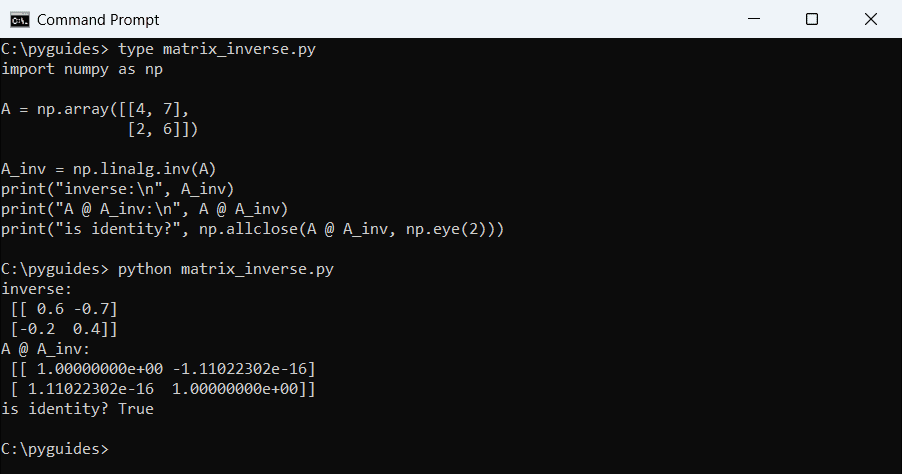 np.allclose() is the right check, since floating-point results are rarely exactly 0 and 1.
@ is matrix multiplication. Don’t use *, which multiplies element by element. For building matrices in the first place, see making a matrix in Python.
Solving equations: use solve() instead of inv()
The most common reason to want an inverse is solving Ax = b. Here three receipts tell us how many coffees, bagels and juices were bought and the totals. What does each item cost?
import numpy as np # three receipts: coffees, bagels, juices bought -> total paid (USD) counts = np.array([[2, 1, 1], [1, 2, 0], [1, 0, 3]]) totals = np.array([16.75, 11.25, 18.50]) prices_inv = np.linalg.inv(counts) @ totals # works... prices = np.linalg.solve(counts, totals) # ...but solve is the better tool for item, price in zip(["coffee", "bagel", "juice"], prices): print(f"{item:<7} ${price:.2f}") print("same answer:", np.allclose(prices, prices_inv))Output:
coffee $4.25 bagel $3.50 juice $4.75 same answer: True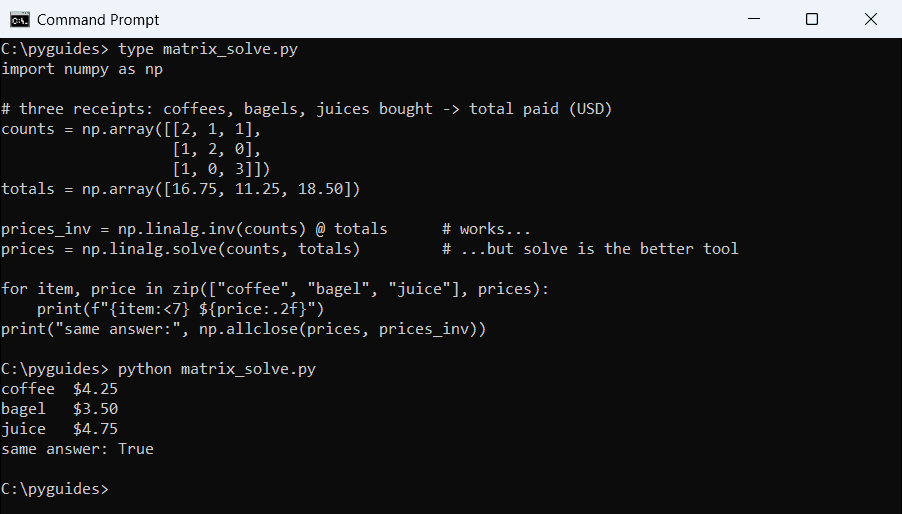 Both approaches find the prices, but solve() skips computing the full inverse.
np.linalg.solve() is faster and more accurate than inv(A) @ b, because it never builds the inverse. Here’s the difference I measured on a 500 by 500 system:
import timeit import numpy as np rng = np.random.default_rng(0) M = rng.random((500, 500)) b = rng.random(500) t_inv = timeit.timeit(lambda: np.linalg.inv(M) @ b, number=50) t_solve = timeit.timeit(lambda: np.linalg.solve(M, b), number=50) err_inv = np.abs(M @ (np.linalg.inv(M) @ b) - b).max() err_solve = np.abs(M @ np.linalg.solve(M, b) - b).max() print(f"inv() then @ : {t_inv:.3f} s, max error {err_inv:.1e}") print(f"solve() : {t_solve:.3f} s, max error {err_solve:.1e}")Output:
inv() then @ : 2.046 s, max error 4.0e-13 solve() : 3.948 s, max error 1.4e-13What happens with a singular matrix?
A matrix whose rows depend on each other has a determinant of 0 and no inverse. NumPy raises LinAlgError. The pseudo-inverse, pinv(), still gives a best-fit answer:
import numpy as np S = np.array([[1, 2], [2, 4]]) # second row is just 2 x the first print("determinant:", np.linalg.det(S)) try: np.linalg.inv(S) except np.linalg.LinAlgError as err: print("LinAlgError:", err) print("pseudo-inverse:\n", np.linalg.pinv(S).round(4))Output:
determinant: 0.0 LinAlgError: Singular matrix pseudo-inverse: [[0.04 0.08] [0.08 0.16]]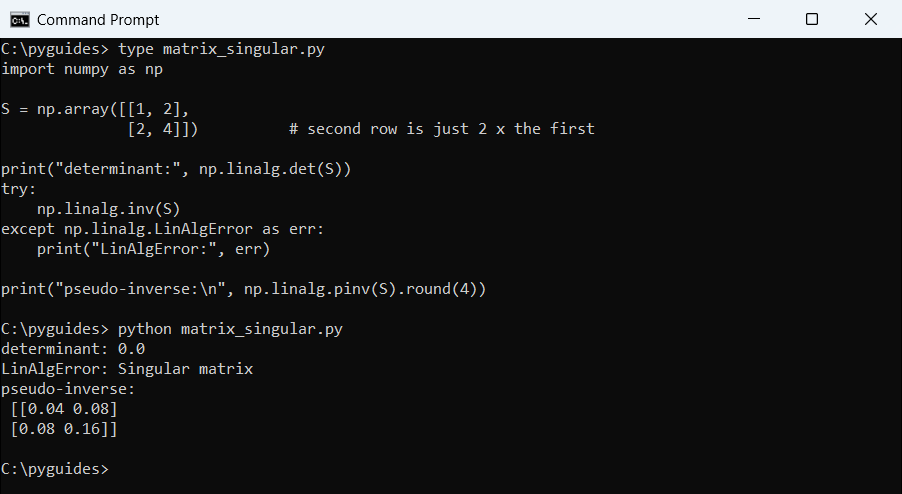 The second row is twice the first, so the matrix is singular. pinv() works anyway.
pinv() also handles non-square matrices, which is useful for least-squares fitting.
Checking if a matrix is close to singular
Some matrices can technically be inverted but are so close to singular that tiny input changes swing the answer wildly. The condition number warns you:
import numpy as np good = np.array([[4.0, 7.0], [2.0, 6.0]]) shaky = np.array([[1.0, 1.0], [1.0, 1.0000001]]) for name, M in [("good", good), ("shaky", shaky)]: print(f"{name:<5} condition number: {np.linalg.cond(M):,.0f}") b = np.array([2.0, 2.0]) print(np.linalg.solve(shaky, b)) print(np.linalg.solve(shaky, b + [0, 0.0001])) # tiny change, huge swingOutput:
good condition number: 10 shaky condition number: 40,000,002 [2. 0.] [-997.99999942 999.99999942]When I see a condition number in the millions or more, I don’t trust the digits much. Rescale your data or rethink the model before relying on the inverse.
Inverse of a matrix without NumPy
For learning, or when you need exact answers, Gauss-Jordan elimination with Python’s Fraction type gives a precise inverse with no rounding at all:
from fractions import Fraction def inverse(matrix): n = len(matrix) # augment [A | I] with exact fractions aug = [[Fraction(x) for x in row] + [Fraction(int(i == j)) for j in range(n)] for i, row in enumerate(matrix)] for col in range(n): pivot = next((r for r in range(col, n) if aug[r][col] != 0), None) if pivot is None: raise ValueError("matrix is singular") aug[col], aug[pivot] = aug[pivot], aug[col] p = aug[col][col] aug[col] = [x / p for x in aug[col]] for r in range(n): if r != col and aug[r][col] != 0: f = aug[r][col] aug[r] = [a - f * b for a, b in zip(aug[r], aug[col])] return [row[n:] for row in aug] for row in inverse([[4, 7], [2, 6]]): print([str(x) for x in row])Output:
['3/5', '-7/10'] ['-1/5', '2/5']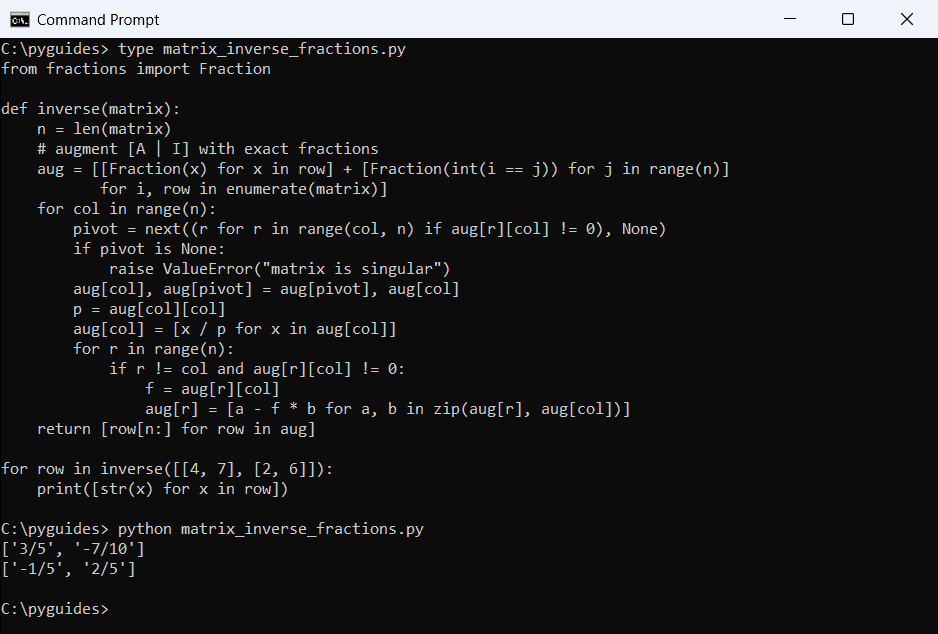 Exact fractions: 3/5 is the 0.6 NumPy printed, and -7/10 is -0.7.
It’s far slower than NumPy on big matrices, so I treat it as a teaching tool. The row operations use list comprehensions; see list of lists in Python for more on nested lists.
Matrix inverse functions at a glance
| np.linalg.inv(A) | The inverse of a square, non-singular matrix |
| np.linalg.solve(A, b) | Solving Ax = b (preferred over inv) |
| np.linalg.pinv(A) | Singular or non-square matrices |
| np.linalg.det(A) | Checking for singularity (det = 0) |
| np.linalg.cond(A) | How sensitive the inverse is to errors |
For more on NumPy and matrices, try these guides:
- NumPy matrix in Python
- Create an empty matrix
- Principal component analysis in Python
- Monte Carlo simulation in Python
Frequently asked questions
How do I find the inverse of a matrix in Python?
Use numpy.linalg.inv(A) on a square NumPy array. Verify it with np.allclose(A @ A_inv, np.eye(n)).
Why do I get LinAlgError: Singular matrix?
The matrix has no inverse because its rows or columns are linearly dependent. Use np.linalg.pinv() or fix the data.
Should I use inv() to solve linear equations?
No. np.linalg.solve(A, b) is faster and more accurate.
Can I invert a non-square matrix?
Not with inv(). Use the pseudo-inverse, np.linalg.pinv().
How do I get an exact inverse with fractions?
Use Gauss-Jordan elimination with fractions.Fraction, as shown above, or a symbolic library such as SymPy.
Where is numpy.linalg.inv documented?
See numpy.linalg.inv in the NumPy reference.






 English (US)