
 3 weeks ago
48
Club.noww.in
Python insertion sort builds a sorted list one item at a time: take the next value, shift every bigger value one place right, and drop the value into the gap. It’s how most people sort a hand of cards:
for i in range(1, len(a)): key, j = a[i], i - 1 while j >= 0 and a[j] > key: a[j + 1] = a[j]; j -= 1 a[j + 1] = keyI traced and timed every version here on Python 3.12.5, so the pass-by-pass output and comparison counts are real.
You’ll see the algorithm step by step, a version with key and reverse for sorting records, when it’s fast and when it’s slow, how it compares to sorted(), and the bisect shortcut.
How insertion sort works in Python
Think of everything left of position i as already sorted. Each pass takes a[i], slides larger values right, and inserts it where it belongs. Printing each pass makes that visible:
def insertion_sort(items, show=False): a = list(items) # sort a copy for i in range(1, len(a)): key = a[i] j = i - 1 while j >= 0 and a[j] > key: # shift bigger items one place right a[j + 1] = a[j] j -= 1 a[j + 1] = key # drop the key into the gap if show: print(f"pass {i}: insert {key:>2} -> {a}") return a print(insertion_sort([29, 10, 14, 37, 13], show=True))Output:
pass 1: insert 10 -> [10, 29, 14, 37, 13] pass 2: insert 14 -> [10, 14, 29, 37, 13] pass 3: insert 37 -> [10, 14, 29, 37, 13] pass 4: insert 13 -> [10, 13, 14, 29, 37] [10, 13, 14, 29, 37]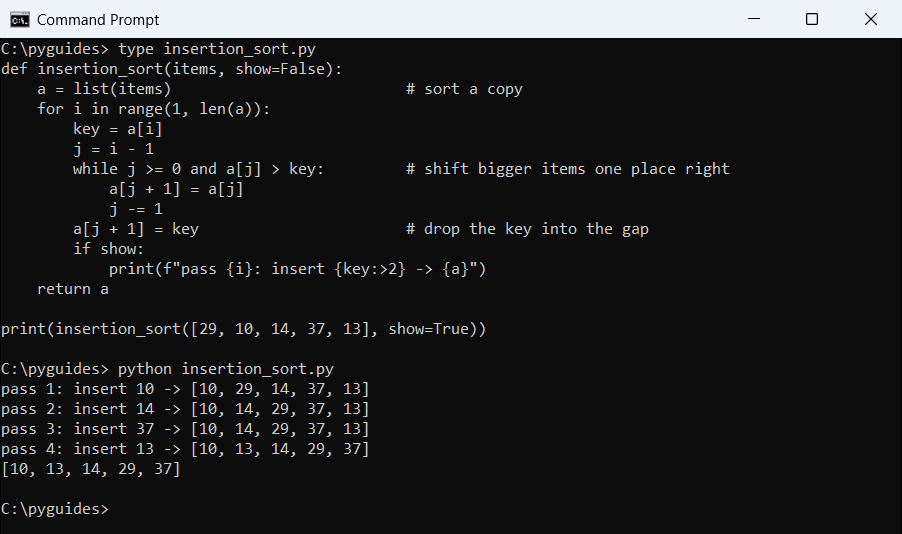 After pass 4, the whole list is sorted. Each pass grows the sorted part on the left by one.
The function sorts a copy, so the original list is left alone. Drop the list(items) line if you want an in-place sort like list.sort().
Insertion sort with key and reverse (sorting records)
Your real data is usually records, not bare numbers. Adding key and reverse arguments, like the built-ins have, lets you sort orders by total:
def insertion_sort(items, key=lambda x: x, reverse=False): a = list(items) for i in range(1, len(a)): item, k = a[i], key(a[i]) j = i - 1 while j >= 0 and ((key(a[j]) < k) if reverse else (key(a[j]) > k)): a[j + 1] = a[j] j -= 1 a[j + 1] = item return a orders = [("Austin", 89.50), ("Denver", 42.00), ("Boston", 89.50), ("Tampa", 15.25), ("Reno", 42.00)] for city, total in insertion_sort(orders, key=lambda o: o[1]): print(f"{city:<7} ${total:>6.2f}") # ties keep their original order (stable) print([c for c, _ in insertion_sort(orders, key=lambda o: o[1], reverse=True)])Output:
Tampa $ 15.25 Denver $ 42.00 Reno $ 42.00 Austin $ 89.50 Boston $ 89.50 ['Austin', 'Boston', 'Denver', 'Reno', 'Tampa']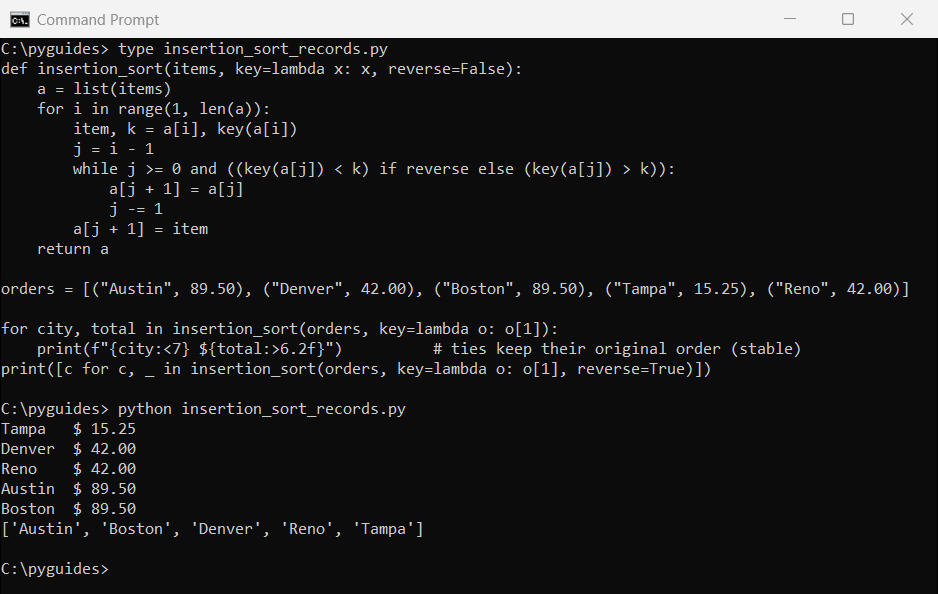 Austin and Boston both have $89.50 and stay in their original order; that’s what a stable sort means.
Insertion sort is stable because it only moves an item past values that are strictly greater. Python’s own sorted() is stable too. See sorting a list of tuples for the built-in way.
When is insertion sort fast or slow?
On already sorted data it does one comparison per item, which is linear time. On reversed data it compares every pair, which is quadratic. Counting comparisons for 1,000 items shows the gap:
import random def count_comparisons(items): a, comps = list(items), 0 for i in range(1, len(a)): key, j = a[i], i - 1 while j >= 0: comps += 1 if a[j] <= key: break a[j + 1] = a[j] j -= 1 a[j + 1] = key return comps n = 1_000 random.seed(1) nearly = list(range(n)) for i in random.sample(range(n - 1), 20): # swap 20 neighboring pairs nearly[i], nearly[i + 1] = nearly[i + 1], nearly[i] cases = {"already sorted": list(range(n)), "nearly sorted": nearly, "random": random.sample(range(n), n), "reversed": list(range(n, 0, -1))} for name, data in cases.items(): print(f"{name:<15} {count_comparisons(data):>8,} comparisons")Output:
already sorted 999 comparisons nearly sorted 1,019 comparisons random 253,231 comparisons reversed 499,500 comparisons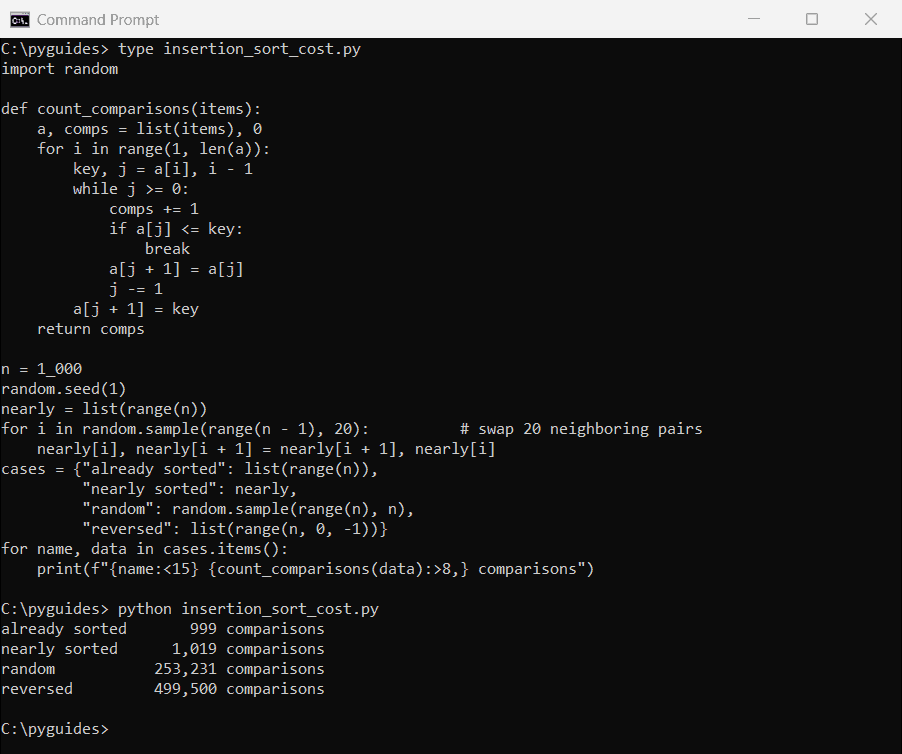 999 comparisons for sorted input versus about half a million for reversed input.
| Best | O(n) | Already or nearly sorted |
| Average | O(n²) | Random order |
| Worst | O(n²) | Reverse order |
| Extra memory | O(1) | Sorts in place |
Insertion sort vs Python’s sorted()
For your real programs, use sorted() or list.sort(). They run Timsort in C, which actually uses insertion sort on short runs internally. On 3,000 random numbers the difference is huge:
import random import timeit def insertion_sort(a): a = list(a) for i in range(1, len(a)): key, j = a[i], i - 1 while j >= 0 and a[j] > key: a[j + 1] = a[j] j -= 1 a[j + 1] = key return a data = random.sample(range(1_000_000), 3_000) assert insertion_sort(data) == sorted(data) t_ins = timeit.timeit(lambda: insertion_sort(data), number=3) / 3 t_built = timeit.timeit(lambda: sorted(data), number=3) / 3 print(f"insertion sort: {t_ins:.3f} s | sorted(): {t_built * 1000:.3f} ms")Output:
insertion sort: 0.138 s | sorted(): 0.253 msInsertion sort is still worth knowing for interviews, for tiny lists, and for understanding how other algorithms work. Compare it with selection sort and the rest in sorting algorithms in Python.
Keeping a list sorted with bisect.insort
If you add items one at a time and want the list always sorted, bisect.insort() does insertion sort’s “find the spot and insert” step with a binary search:
import bisect leaderboard = [120, 340, 560, 780] # kept sorted at all times for new_score in [450, 90, 900, 560]: bisect.insort(leaderboard, new_score) # binary search for the spot, then insert print(f"added {new_score:>3}: {leaderboard}") print("rank of 600:", len(leaderboard) - bisect.bisect_right(leaderboard, 600) + 1)Output:
added 450: [120, 340, 450, 560, 780] added 90: [90, 120, 340, 450, 560, 780] added 900: [90, 120, 340, 450, 560, 780, 900] added 560: [90, 120, 340, 450, 560, 560, 780, 900] rank of 600: 3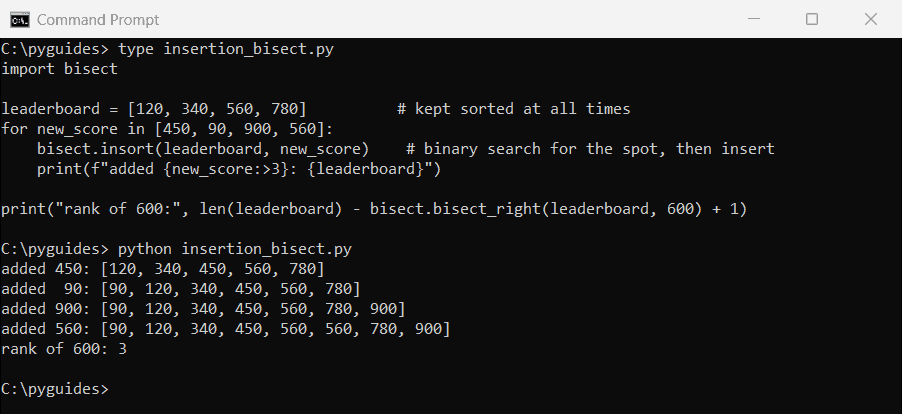 Each new score lands in the right place without re-sorting the whole list.
Finding the spot is a binary search, the same idea as in binary search in Python; the insert itself still shifts items, so it suits lists of moderate size.
More algorithm walkthroughs to try:
- Breadth first search in Python
- Depth first search in Python
- Greatest common divisor in Python
- Python while loop
Frequently asked questions
How does insertion sort work in Python?
It walks the list from left to right, and for each item shifts larger items in the sorted part one place right, then inserts the item into the gap.
What is the time complexity of insertion sort?
O(n²) on average and in the worst case, and O(n) when the list is already sorted.
Is insertion sort stable?
Yes. Equal items keep their original order because an item only moves past strictly greater values.
When should I use insertion sort?
For very small or nearly sorted lists, or for learning. For everything else, use sorted() or list.sort().
Does Python’s sort use insertion sort?
Partly. Python’s Timsort uses binary insertion sort on short runs, then merges those runs.
What does bisect.insort do?
It inserts an item into an already sorted list at the right position. See bisect in the Python docs.







 English (US)