
 1 month ago
73
Club.noww.in
Yes, you can put a class in a class in Python. Define the inner class inside the outer class body, and reach it as Outer.Inner. It’s called a nested or inner class, and it groups a helper type with its owner:
class Store: class Address: ... Store.Address("120 Pine St", "Portland", "OR")Each example was saved as a .py file and run with Python 3.12.5; the screenshots are the actual Windows Command Prompt windows.
Below, I’ll build a nested class, show the scope rule that causes most NameErrors, explain how an inner class can reach the outer object, and cover nested enums and dataclasses.
How to define a class inside a class in Python
Indent the inner class under the outer one, like a method. From inside the outer class you write Store.Address, and from outside it works exactly the same way:
class Store: class Address: def __init__(self, street, city, state): self.street, self.city, self.state = street, city, state def label(self): return f"{self.street}, {self.city}, {self.state}" def __init__(self, name, street, city, state): self.name = name self.address = Store.Address(street, city, state) shop = Store("Corner Books", "120 Pine St", "Portland", "OR") print(shop.name, "-", shop.address.label()) home = Store.Address("9 Elm Ave", "Tulsa", "OK") # create one from outside print(home.label()) print(type(home).__qualname__)Output:
Corner Books - 120 Pine St, Portland, OR 9 Elm Ave, Tulsa, OK Store.Address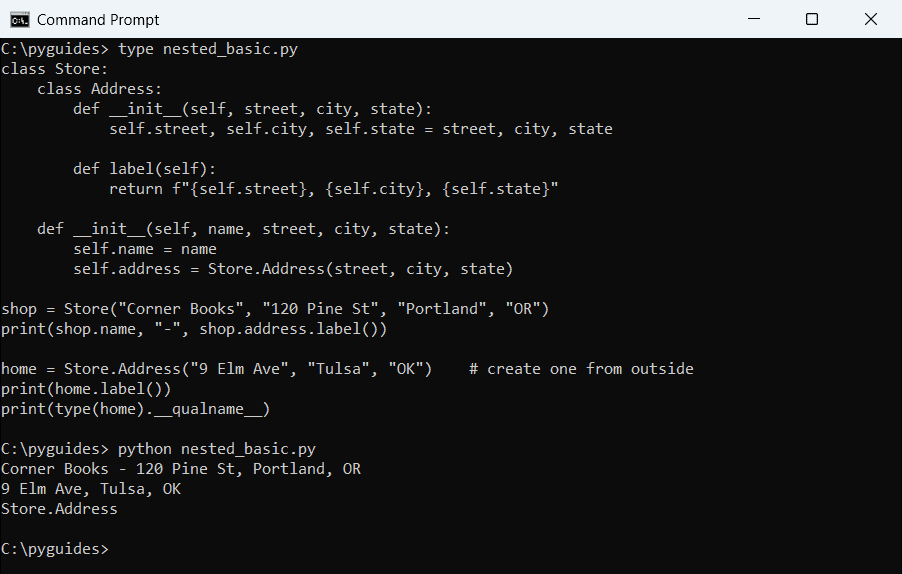 The inner class works anywhere you can see the outer class. Its qualified name is Store.Address.
Nesting doesn’t make Address private. It just puts the name inside the Store namespace, so nobody confuses it with some other Address class.
Why does a nested class give a NameError?
Here’s the catch: names defined in a class body aren’t visible inside its methods. So a bare Item(...) inside a method fails, even though Item is right there:
class Order: class Item: def __init__(self, name, price): self.name, self.price = name, price def __init__(self): self.items = [] def add_wrong(self, name, price): self.items.append(Item(name, price)) # bare name: not in scope here def add(self, name, price): self.items.append(self.Item(name, price)) # or Order.Item(...) order = Order() try: order.add_wrong("Coffee", 4.50) except NameError as err: print("NameError:", err) order.add("Coffee", 4.50) order.add("Bagel", 2.75) print([i.name for i in order.items], f"${sum(i.price for i in order.items):.2f}")Output:
NameError: name 'Item' is not defined ['Coffee', 'Bagel'] $7.25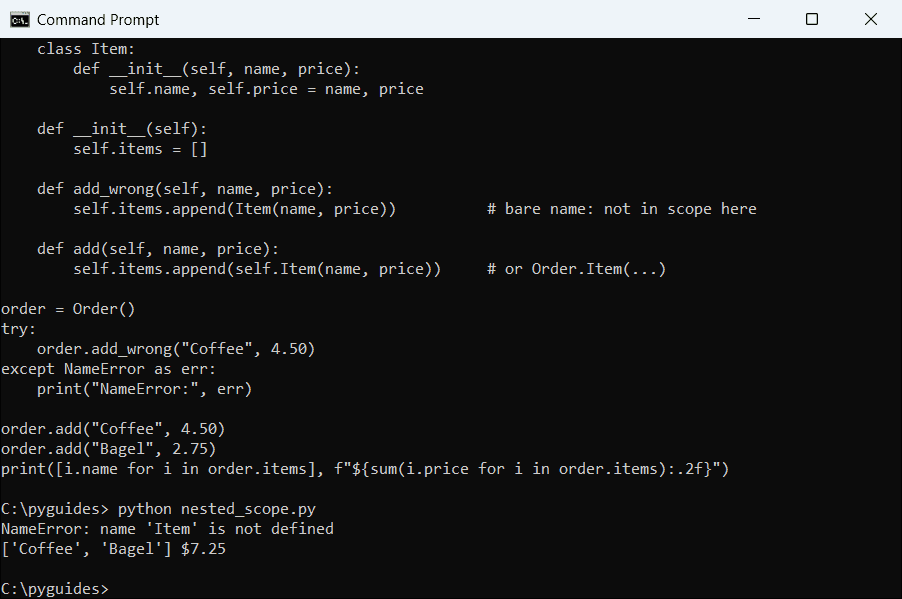 Item alone raises NameError. self.Item or Order.Item finds it.
Methods skip the class scope when they look up names; they go straight from local to global. Python variable scope walks through the full lookup order.
Can an inner class access the outer class?
Not on its own. An inner class object has no hidden link to an instance of the outer class, unlike Java’s inner classes. If it needs one, pass the outer object in:
class Account: rate = 0.04 def __init__(self, owner, balance): self.owner, self.balance = owner, balance class Statement: def __init__(self, account): self.account = account # pass the outer object in def summary(self): a = self.account interest = a.balance * Account.rate return f"{a.owner}: ${a.balance:,.2f}, yearly interest ${interest:,.2f}" acct = Account("Maria Lopez", 12_500.00) print(Account.Statement(acct).summary()) try: print(Account.Statement(acct).owner) except AttributeError as err: print("AttributeError:", err)Output:
Maria Lopez: $12,500.00, yearly interest $500.00 AttributeError: 'Statement' object has no attribute 'owner'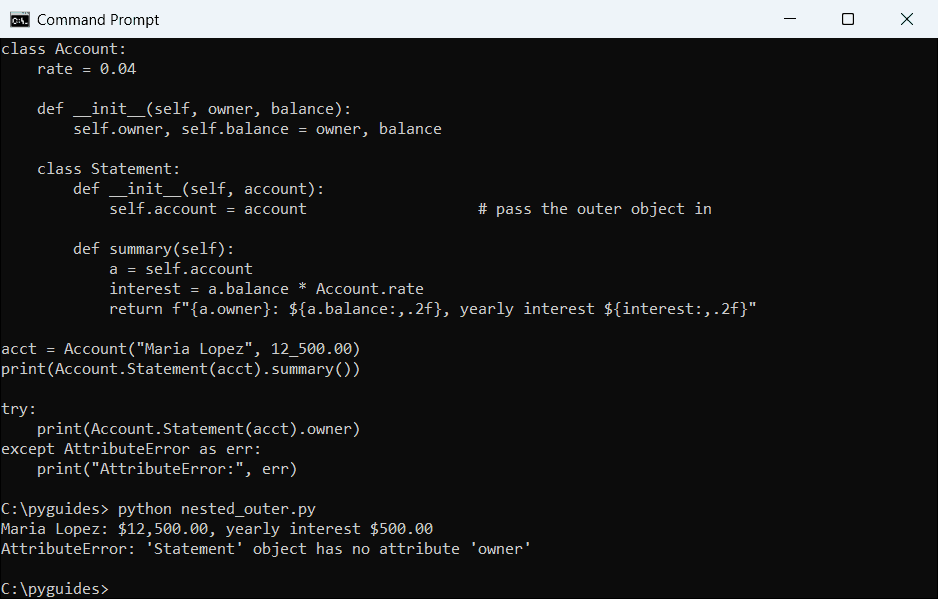 The Statement only knows about the account because we handed it in.
Class-level values like Account.rate are easy, since you can always name the outer class. Instance data like owner needs the instance.
Nesting an Enum inside a class
This is the nested class I use most. Status codes that only make sense for one class read nicely as Ticket.Status.OPEN:
from enum import Enum class Ticket: class Status(Enum): OPEN = "open" IN_PROGRESS = "in progress" CLOSED = "closed" def __init__(self, title): self.title = title self.status = Ticket.Status.OPEN def close(self): self.status = Ticket.Status.CLOSED t = Ticket("Printer jam in Dallas office") print(t.title, "->", t.status.value) t.close() print(t.title, "->", t.status.value) print([s.name for s in Ticket.Status])Output:
Printer jam in Dallas office -> open Printer jam in Dallas office -> closed ['OPEN', 'IN_PROGRESS', 'CLOSED']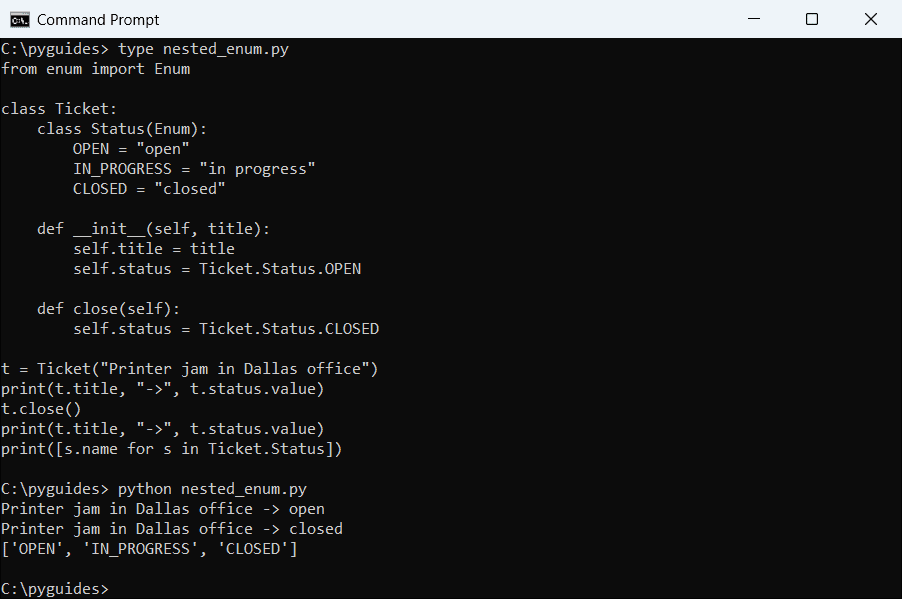 Ticket.Status keeps the allowed values right next to the class that uses them.
You’ll see the same idea in Django, where models carry a nested Meta class for settings, and in many libraries that group config this way.
Nested classes with dataclasses
Dataclasses nest the same way. Quote the type hint as "Employee.Contact", because the name Employee doesn’t exist yet while its body is still running:
from dataclasses import dataclass, field @dataclass class Employee: @dataclass class Contact: email: str phone: str name: str city: str contact: "Employee.Contact" skills: list = field(default_factory=list) e = Employee("Sam Carter", "Raleigh", Employee.Contact("sam@example.com", "919-555-0142")) print(e) print(e.contact.email)Output:
Employee(name='Sam Carter', city='Raleigh', contact=Employee.Contact(email='sam@example.com', phone='919-555-0142'), skills=[]) sam@example.comFor more on these, my Python dataclass guide covers fields, defaults and field(default_factory=...).
When to use a class in a class (and when not to)
| Only the outer class uses it | Other modules need it too |
| Small helper types, enums, config | Large classes with lots of logic |
| You want Outer.Inner naming | You’d need to pass the outer object everywhere |
| Stays short and readable | Indentation gets three levels deep |
My rule of thumb: if the inner class grows past a screen, move it to module level. If you’re really modeling “has a”, look at composition vs inheritance instead.
Here’s where I’d go next with Python classes:
- Constructor in Python
- Python classmethod
- Abstract base classes in Python
- isinstance and issubclass examples
- Constants in Python
Frequently asked questions
Can you have a class inside a class in Python?
Yes. Define it in the outer class body and use it as Outer.Inner. Python calls it a nested or inner class.
How do I create an object of an inner class?
Call it through the outer class: Outer.Inner(args). Inside the outer class’s methods, self.Inner(args) works too.
Why can’t my method see the inner class?
Methods don’t look up names in the class body, so a bare Inner is a NameError. Prefix it with self. or the outer class name.
Can an inner class access outer class variables?
Class variables, yes, by writing Outer.name. Instance variables only if you pass an outer instance to the inner class.
Is a nested class private in Python?
No. Anyone can use Outer.Inner. Nesting is about organizing names, not hiding them.
Are nested classes Pythonic?
They’re fine for small helpers like enums. The Python classes tutorial explains the scoping rules behind them.








 English (US)