
 1 month ago
100
Club.noww.in
Checking a variable’s type in Python takes one of two built-ins. type(x) tells you exactly what x is, and isinstance(x, SomeType) tells you whether it’s that type or a subclass of it:
price = 19.99 type(price) # <class 'float'> isinstance(price, float) # True isinstance(price, (int, float)) # True: either typeI tested everything below on Python 3.12.5 with NumPy 2.5.3; the screenshots are the real Command Prompt output.
Use isinstance() for checks in your code and type() when you want to see or print the type. Below you’ll see why, plus numbers, floats, dates and the surprise that True counts as an integer.
Using type() to see a variable’s type
type() returns the class of the object. Add .__name__ when you only want the name as text:
values = [42, 19.99, "Austin", True, None, [1, 2], {"TX": 1}] for v in values: print(f"{v!r:12} -> {type(v).__name__}") print(type(42) is int) # compare a type with `is`Output:
42 -> int 19.99 -> float 'Austin' -> str True -> bool None -> NoneType [1, 2] -> list {'TX': 1} -> dict True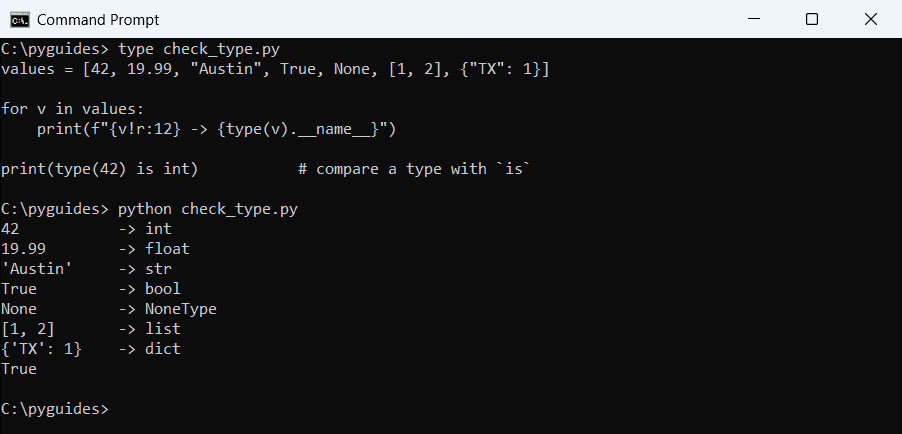 type() on seven common values. Note that None has its own type, NoneType.
When you compare types directly, use is, as in type(x) is int. There’s exactly one int class, so identity is the right test.
type() vs isinstance(): which should you use?
isinstance() accepts subclasses and a tuple of types, which makes it the better choice almost every time you’re making a decision in code:
price = 19.99 print(isinstance(price, float)) # True print(isinstance(price, (int, float))) # either one: True print(isinstance("19.99", (int, float))) # a string isn't a number # isinstance also accepts subclasses, type() doesn't class Discount(float): pass d = Discount(0.15) print("isinstance:", isinstance(d, float), "| type() is float:", type(d) is float)Output:
True True False isinstance: True | type() is float: FalseDiscount is a kind of float, so isinstance() says yes while type() is float says no. Code that rejects subclasses usually breaks for no good reason. isinstance and issubclass in Python has more examples.
Why does isinstance(True, int) return True?
Because bool is a subclass of int: True behaves like 1 and False like 0. That’s useful for counting, but it means a plain isinstance(x, int) lets booleans through:
print("isinstance(True, int):", isinstance(True, int)) # bool is a subclass of int print("type(True) is int :", type(True) is int) print("True + True :", True + True) def is_int(value): return isinstance(value, int) and not isinstance(value, bool) for v in [7, True, 7.0]: print(f"is_int({v!r}) -> {is_int(v)}")Output:
isinstance(True, int): True type(True) is int : False True + True : 2 is_int(7) -> True is_int(True) -> False is_int(7.0) -> False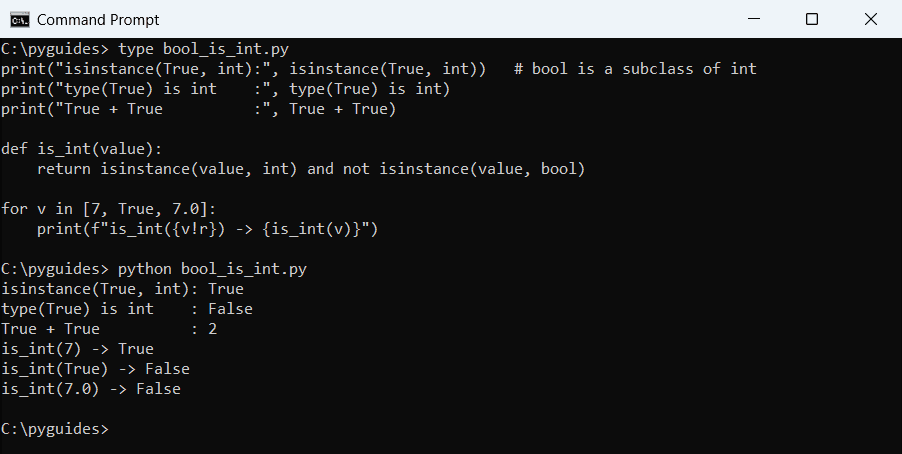 True + True is 2. The helper excludes booleans explicitly.
If a form field or JSON value should be a whole number, exclude bool as shown. Checking if a variable is an integer and checking for a boolean go further.
How to check if a variable is a number in Python
numbers.Number covers every numeric type, including Decimal, complex numbers and your own classes, as long as they register. Exclude bool again unless you want it:
import numbers from decimal import Decimal def is_number(value): return isinstance(value, numbers.Number) and not isinstance(value, bool) for v in [7, 19.99, Decimal("19.99"), 2 + 3j, "19.99", True, None]: print(f"{v!r:18} -> {is_number(v)}") print("Decimal is a Real?", isinstance(Decimal("19.99"), numbers.Real))Output:
7 -> True 19.99 -> True Decimal('19.99') -> True (2+3j) -> True '19.99' -> False True -> False None -> False Decimal is a Real? False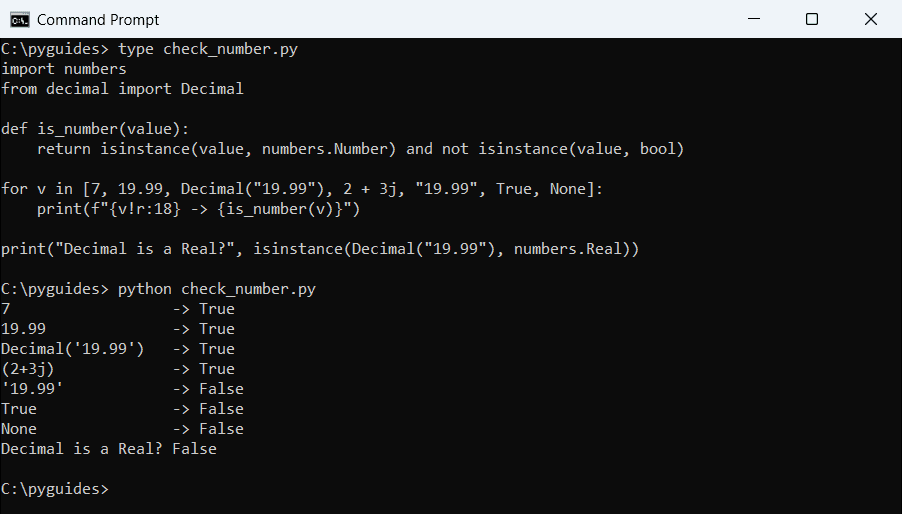 Strings, booleans and None are rejected. Decimal is a number but not a numbers.Real.
That last line catches people out: Decimal deliberately isn’t registered as Real, so check numbers.Number if money values stored as Decimal should pass.
Check if a variable is a float
isinstance(x, float) answers the type question. Whether a string could become a float is a different question, and float() inside try answers it best:
for v in [19.99, 20.0, 20, "19.99"]: print(f"{v!r:8} isinstance float: {isinstance(v, float)}") print((20.0).is_integer()) # a float with no fractional part def looks_like_float(text): try: float(text) return True except ValueError: return False print(looks_like_float("19.99"), looks_like_float("$19.99"), "12.5".isdigit())Output:
19.99 isinstance float: True 20.0 isinstance float: True 20 isinstance float: False '19.99' isinstance float: False True True False False"12.5".isdigit() is False because the dot isn’t a digit, which is why string methods are the wrong tool here. Checking if a string is an integer or float covers that case properly.
Check if a variable is a datetime or a date
Here’s a subtle one: datetime is a subclass of date, so every datetime also passes isinstance(x, date). Check for the subclass first:
from datetime import date, datetime launch = datetime(2026, 10, 8, 14, 0) # a date AND a time holiday = date(2026, 11, 26) # Thanksgiving 2026 print("isinstance(launch, date) :", isinstance(launch, date)) # True! print("isinstance(launch, datetime):", isinstance(launch, datetime)) print("type(launch) is date :", type(launch) is date) print("isinstance(holiday, datetime):", isinstance(holiday, datetime)) def kind(value): if isinstance(value, datetime): # check the subclass FIRST return "datetime" if isinstance(value, date): return "date" return "neither" print(kind(launch), kind(holiday), kind("2026-11-26"))Output:
isinstance(launch, date) : True isinstance(launch, datetime): True type(launch) is date : False isinstance(holiday, datetime): False datetime date neither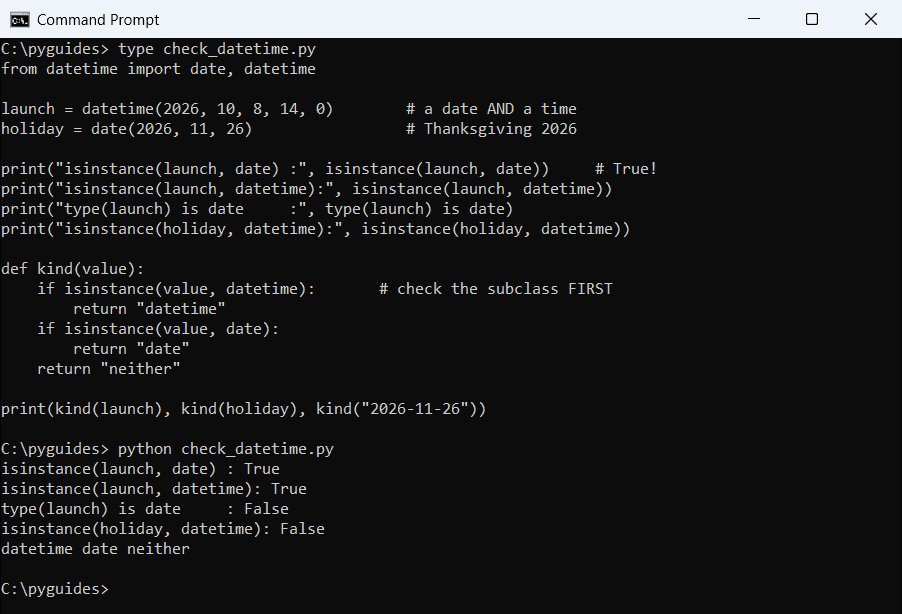 The launch time is a datetime and a date. Checking datetime first keeps the two apart.
The same “most specific first” rule applies to bool and int, and to any class hierarchy of your own.
Checking types with match-case (Python 3.10+)
When you branch on several types, structural pattern matching reads more cleanly than a chain of isinstance() calls:
def describe(value): match value: case bool(): # before int, because bool is an int return "yes/no" case int() | float(): return "number" case str(): return "text" case None: return "missing" case _: return type(value).__name__ print([describe(v) for v in [True, 7, 2.5, "TX", None, [1]]])Output:
['yes/no', 'number', 'number', 'text', 'missing', 'list']Put bool() before int(), for the reason you’ve already seen. Otherwise True would match the int() case.
NumPy types: why np.int64 isn’t an int
Values that come out of NumPy arrays have NumPy types. np.float64 happens to subclass float, but np.int64 doesn’t subclass int:
import numbers import numpy as np count = np.int64(5) price = np.float64(19.99) print("isinstance(np.int64, int) :", isinstance(count, int)) print("isinstance(np.int64, Integral) :", isinstance(count, numbers.Integral)) print("isinstance(np.float64, float) :", isinstance(price, float)) print("np.issubdtype(int64, integer) :", np.issubdtype(count.dtype, np.integer))Output:
isinstance(np.int64, int) : False isinstance(np.int64, Integral) : True isinstance(np.float64, float) : True np.issubdtype(int64, integer) : TrueIf your code receives values from NumPy or pandas, check against numbers.Integral or numbers.Real rather than int and float, and both kinds will pass.
How to check the type of a variable: cheat sheet
| What type is it? | type(x) or type(x).__name__ |
| Is it a string? | isinstance(x, str) |
| Is it a whole number (not bool)? | isinstance(x, int) and not isinstance(x, bool) |
| Is it any number? | isinstance(x, numbers.Number) |
| Is it a float? | isinstance(x, float) |
| Can this text become a float? | float(text) inside try |
| Datetime or plain date? | Check datetime first, then date |
| Is it None? | x is None |
| Several types at once | isinstance(x, (int, float)) |
For None specifically, use is rather than a type check; checking if a variable is None explains why. More type-checking guides:
- isinstance() and issubclass() in Python
- Check if a variable is a string
- Check if a variable is an integer
- Check if a variable is a boolean
- Mutable vs immutable types in Python
Frequently asked questions
How do I check the type of a variable in Python?
Use type(x) to see it, or isinstance(x, SomeType) to test it. isinstance() is the better choice for checks because it accepts subclasses.
What’s the difference between type() and isinstance()?
type() returns the exact class. isinstance() returns True for that class or any subclass, and accepts a tuple of types.
Why is isinstance(True, int) True?
bool is a subclass of int in Python. Add and not isinstance(x, bool) when booleans shouldn’t count.
How do I check if a variable is a number?
isinstance(x, numbers.Number) covers int, float, complex, Decimal and Fraction. Exclude bool if needed.
How do I check if a variable is a datetime?
isinstance(x, datetime). Because datetime is a subclass of date, test for datetime before date.
Can I check a variable’s type with ==?
type(x) == int works, but type(x) is int is the idiomatic form, and isinstance() is usually better still. The isinstance() documentation describes the exact rules.







 English (US)