
 1 month ago
43
Club.noww.in
Breadth first search in Python explores a graph level by level: first the start node, then all its neighbors, then their neighbors, and so on. You build it with a queue from collections.deque and a set of visited nodes:
queue = deque([start]); visited = {start} while queue: node = queue.popleft() for nxt in graph[node]: if nxt not in visited: visited.add(nxt); queue.append(nxt)Every BFS here uses only the standard library, and I ran each one with Python 3.12.5 in Command Prompt.
We’ll write a basic BFS on a map of US flight routes, count hops, find the shortest path, solve a grid maze, traverse a binary tree by level, and see why deque matters.
How breadth first search works
BFS uses a first-in, first-out queue. Nodes are visited in the order they were discovered, so everything one step away gets visited before anything two steps away.
- Put the start node in the queue and mark it visited.
- Take the node at the front of the queue.
- Add each unvisited neighbor to the back of the queue and mark it visited.
- Repeat until the queue is empty (or you find your goal).
BFS in Python with a deque
Here the graph is a dictionary: each city maps to a list of cities with a direct flight. This adjacency-list format is the most common way to store a graph in Python:
from collections import deque routes = { "Seattle": ["Denver", "Chicago"], "Denver": ["Seattle", "Dallas", "Chicago"], "Chicago": ["Seattle", "Denver", "New York", "Atlanta"], "Dallas": ["Denver", "Atlanta", "Miami"], "Atlanta": ["Chicago", "Dallas", "Miami", "New York"], "New York": ["Chicago", "Atlanta", "Boston"], "Miami": ["Dallas", "Atlanta"], "Boston": ["New York"], } def bfs(graph, start): visited = {start} queue = deque([start]) order = [] while queue: city = queue.popleft() # take from the front order.append(city) for nxt in graph[city]: if nxt not in visited: visited.add(nxt) # mark when queued, not when popped queue.append(nxt) # add to the back return order print(bfs(routes, "Seattle"))Output:
['Seattle', 'Denver', 'Chicago', 'Dallas', 'New York', 'Atlanta', 'Miami', 'Boston']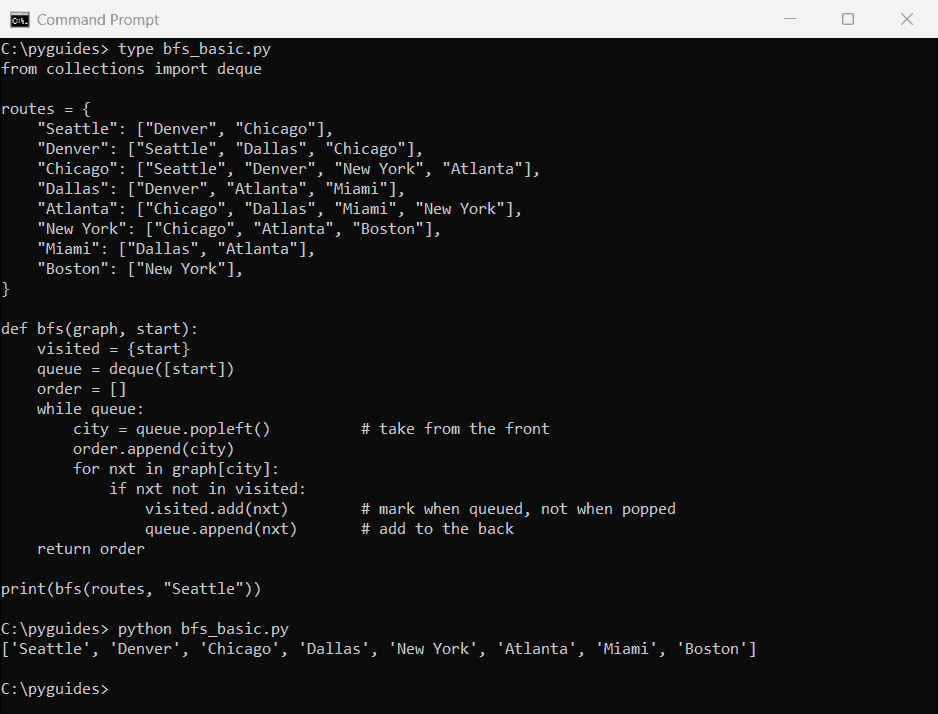 Seattle’s direct neighbors come first, then cities two flights away, then Miami and Boston, three flights out.
I always mark a node visited when it’s added to the queue, not when it’s popped. Otherwise the same city can be queued several times from different neighbors.
Counting levels: how many hops away is each node?
Because BFS moves outward one ring at a time, you can record each node’s distance as you discover it. That’s the number of edges on the shortest route:
from collections import deque routes = { "Seattle": ["Denver", "Chicago"], "Denver": ["Seattle", "Dallas", "Chicago"], "Chicago": ["Seattle", "Denver", "New York", "Atlanta"], "Dallas": ["Denver", "Atlanta", "Miami"], "Atlanta": ["Chicago", "Dallas", "Miami", "New York"], "New York": ["Chicago", "Atlanta", "Boston"], "Miami": ["Dallas", "Atlanta"], "Boston": ["New York"], } def hops_from(graph, start): dist = {start: 0} queue = deque([start]) while queue: city = queue.popleft() for nxt in graph[city]: if nxt not in dist: dist[nxt] = dist[city] + 1 queue.append(nxt) return dist for city, hops in hops_from(routes, "Seattle").items(): print(f"{city:<9} {hops} flight(s) away")Output:
Seattle 0 flight(s) away Denver 1 flight(s) away Chicago 1 flight(s) away Dallas 2 flight(s) away New York 2 flight(s) away Atlanta 2 flight(s) away Miami 3 flight(s) away Boston 3 flight(s) awayStore the distances in a dictionary and it doubles as your visited set. For more on that structure, see dictionaries of lists.
How do you find the shortest path with BFS?
Keep a parent dictionary that records where you came from. When you reach the goal, follow the parents back to the start and reverse the list:
from collections import deque routes = { "Seattle": ["Denver", "Chicago"], "Denver": ["Seattle", "Dallas", "Chicago"], "Chicago": ["Seattle", "Denver", "New York", "Atlanta"], "Dallas": ["Denver", "Atlanta", "Miami"], "Atlanta": ["Chicago", "Dallas", "Miami", "New York"], "New York": ["Chicago", "Atlanta", "Boston"], "Miami": ["Dallas", "Atlanta"], "Boston": ["New York"], } def shortest_path(graph, start, goal): parent = {start: None} queue = deque([start]) while queue: city = queue.popleft() if city == goal: path = [] while city is not None: # walk back through the parents path.append(city) city = parent[city] return path[::-1] for nxt in graph[city]: if nxt not in parent: parent[nxt] = city queue.append(nxt) return None print(" -> ".join(shortest_path(routes, "Seattle", "Miami"))) print(" -> ".join(shortest_path(routes, "Boston", "Dallas"))) print(shortest_path({"A": ["B"], "B": [], "C": []}, "A", "C"))Output:
Seattle -> Denver -> Dallas -> Miami Boston -> New York -> Atlanta -> Dallas None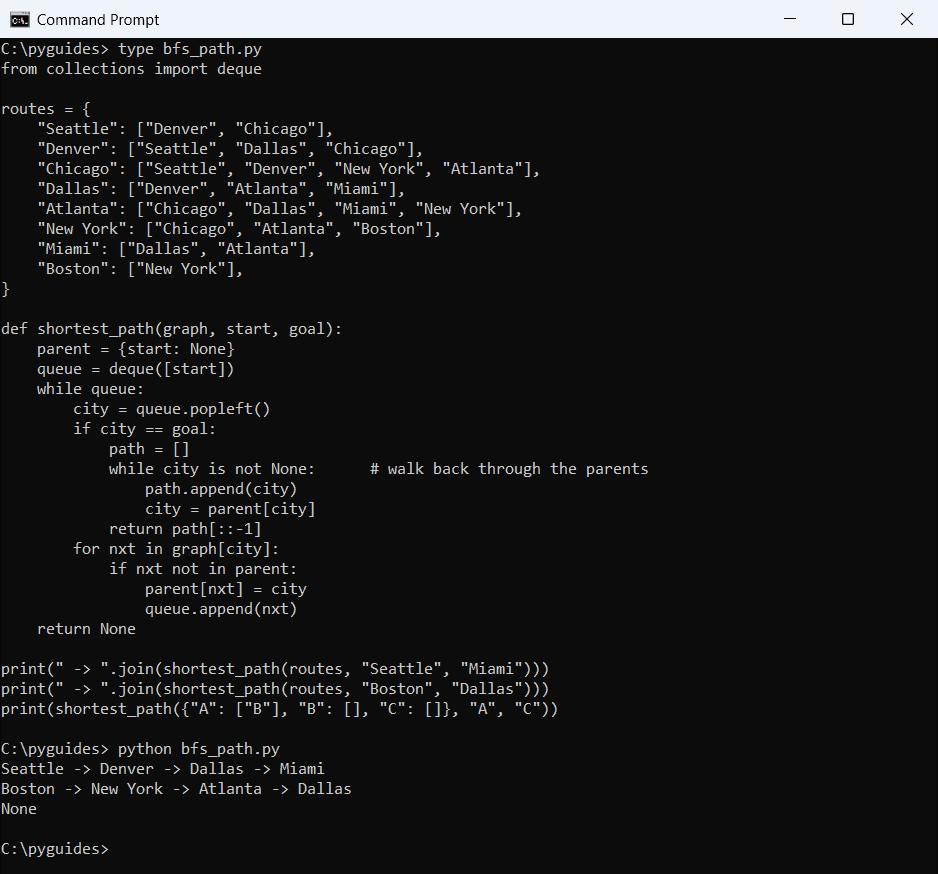 BFS gives the route with the fewest flights. It returns None when the goal can’t be reached.
This only finds the fewest edges. If each flight has a different cost or distance, you need Dijkstra’s algorithm, which swaps the queue for a priority queue.
Solving a maze with breadth first search
A grid is just a graph where each open cell connects to its four neighbors. BFS from the start finds the shortest way to the exit:
from collections import deque maze = [ "S.#.....", ".##.###.", "....#...", "##.##.#.", "...#..#E", ] def solve(maze): rows, cols = len(maze), len(maze[0]) start = next((r, c) for r in range(rows) for c in range(cols) if maze[r][c] == "S") parent = {start: None} queue = deque([start]) while queue: r, c = queue.popleft() if maze[r][c] == "E": path, cell = [], (r, c) while cell: path.append(cell) cell = parent[cell] return path[::-1] for dr, dc in ((1, 0), (-1, 0), (0, 1), (0, -1)): nr, nc = r + dr, c + dc if 0 <= nr < rows and 0 <= nc < cols and maze[nr][nc] != "#" and (nr, nc) not in parent: parent[(nr, nc)] = (r, c) queue.append((nr, nc)) path = solve(maze) print("steps:", len(path) - 1) grid = [list(row) for row in maze] for r, c in path[1:-1]: grid[r][c] = "*" print("\n".join("".join(row) for row in grid))Output:
steps: 15 S.#***** *##*###* ****#..* ##.##.#* ...#..#E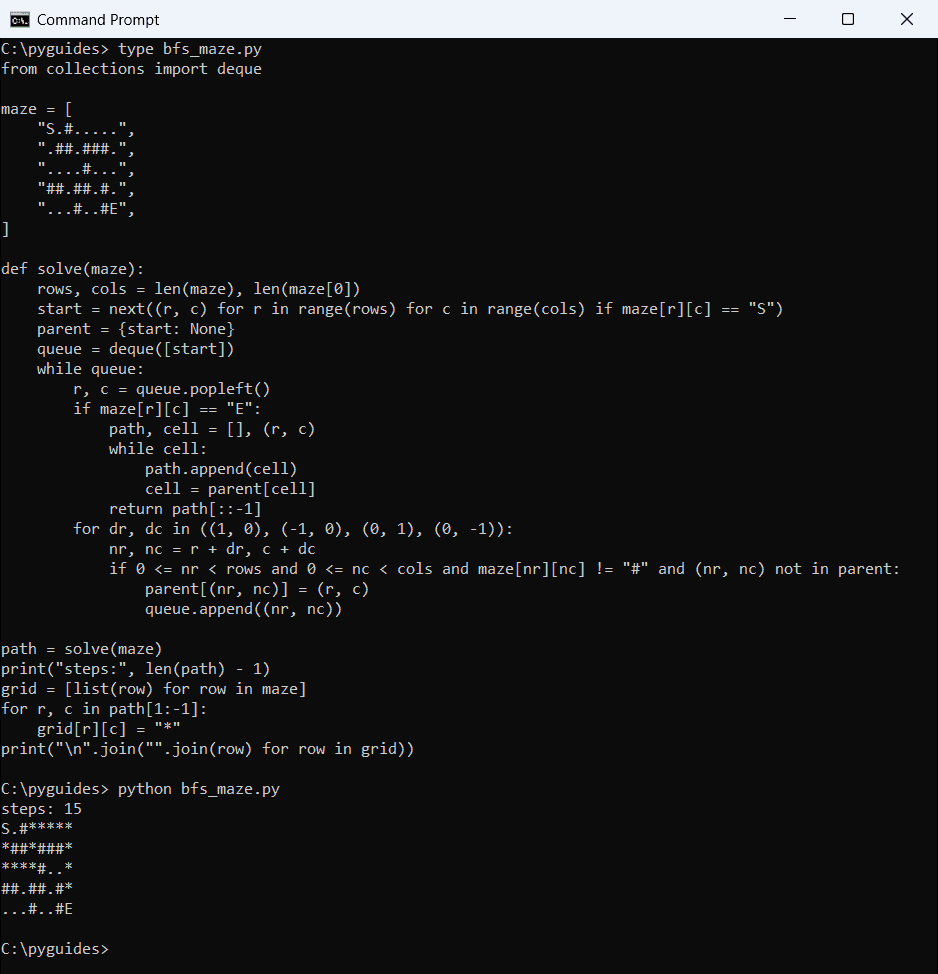 The stars mark the shortest route from S to E. BFS guarantees no shorter path exists.
Storing the maze as a list of lists lets you mark the path in place, which is what the last few lines do.
Level order traversal of a binary tree
On a tree, BFS is called level order traversal. Process the queue one level at a time by looping over its current length:
from collections import deque class Node: def __init__(self, val, left=None, right=None): self.val, self.left, self.right = val, left, right # 50 # / \ # 30 70 # / \ \ # 20 40 80 root = Node(50, Node(30, Node(20), Node(40)), Node(70, None, Node(80))) def level_order(root): levels, queue = [], deque([root]) while queue: level = [] for _ in range(len(queue)): # everything in the queue now is one level node = queue.popleft() level.append(node.val) for child in (node.left, node.right): if child: queue.append(child) levels.append(level) return levels print(level_order(root))Output:
[[50], [30, 70], [20, 40, 80]]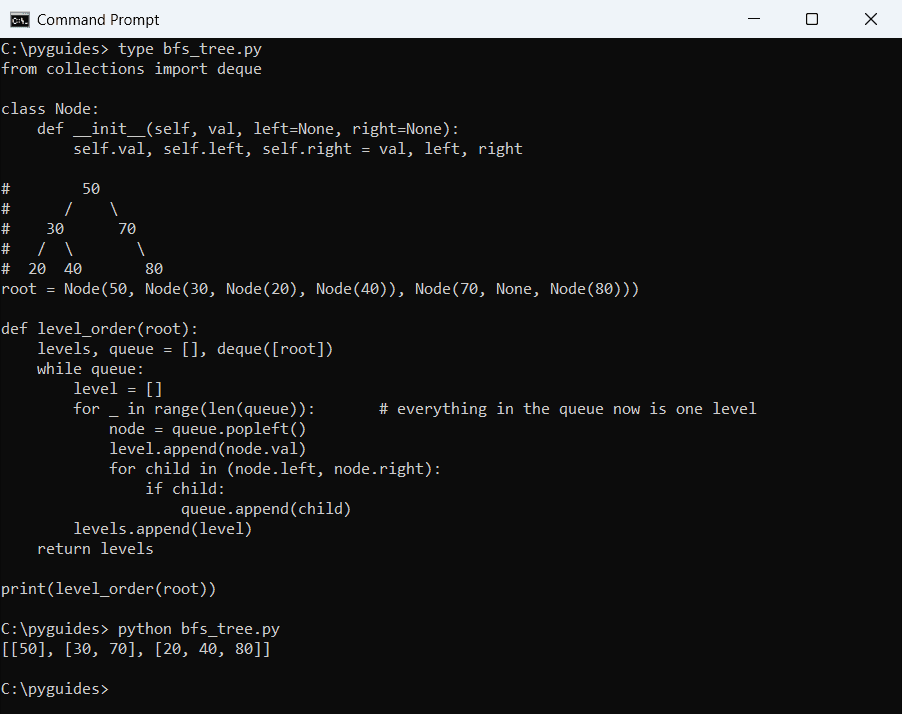 Each inner list is one level of the tree, from the root down.
Trees have no cycles, so you don’t need a visited set here. My Python binary tree guide covers building and searching trees.
Why use deque instead of a list for BFS?
list.pop(0) shifts every remaining item, so it gets slower as the list grows. deque.popleft() takes the same tiny time no matter how long the queue is:
import timeit from collections import deque n = 50_000 list_time = timeit.timeit("q = list(range(n))\nwhile q: q.pop(0)", globals={"n": n}, number=1) deque_time = timeit.timeit("q = deque(range(n))\nwhile q: q.popleft()", globals={"n": n, "deque": deque}, number=1) print(f"list.pop(0): {list_time:.3f} s") print(f"deque.popleft(): {deque_time:.4f} s")Output:
list.pop(0): 2.398 s deque.popleft(): 0.0015 sOn big graphs that difference turns a fast BFS into a slow one, so deque is the right tool every time.
BFS vs DFS
| Data structure | Queue (deque) | Stack or recursion |
| Visits | Level by level | One branch to the end, then backtracks |
| Shortest path (unweighted) | Yes | No |
| Memory | Can be large on wide graphs | Proportional to depth |
| Time | O(V + E) | O(V + E) |
Use BFS when you need the shortest path or the nearest match. Use DFS for things like detecting cycles, topological sorting, or exploring every possible path.
More algorithm guides you might like:
Frequently asked questions
What is breadth first search in Python?
It’s a graph traversal that visits nodes level by level using a queue, usually collections.deque, plus a set of visited nodes.
Why does BFS find the shortest path?
It visits every node one edge away before any node two edges away, so the first time it reaches a node is by the fewest edges.
What is the time complexity of BFS?
O(V + E): each vertex is queued once and each edge is checked once.
Can BFS handle weighted graphs?
Not for shortest paths. Use Dijkstra’s algorithm with a priority queue when edges have different weights.
Should I use a list or deque for the BFS queue?
A deque. popleft() is constant time, while list.pop(0) slows down as the list grows.
Where is deque documented?
See collections.deque in the Python docs.







 English (US)